
Kids’ fillings, crowns and baby root canals
Pediatric Restorative Dentistry in Richmond, VA for cavities, broken teeth and baby teeth that need saving
Your child’s checkup was supposed to be routine. Then you heard “cavity.” Maybe “crown.” Maybe “pulpotomy,” a word most parents have never heard. Everything we offer for kids is on our pediatric dentistry in Richmond page.
Now you’re wondering whether a baby tooth is worth fixing, whether it will hurt, and what it will cost. You may also be wondering what you did wrong. Probably nothing. Cavities are the most common chronic disease of childhood in the U.S., and they happen in careful families too.
At Richmond Pediatric Dentistry & Orthodontics, our specialty-trained pediatric dentists repair kids’ teeth at four offices: Short Pump, the West End, Mechanicsville and Midlothian. We’ll explain every option in plain words, and we accept Virginia Medicaid at all four.
- Four pediatric offices: Short Pump, West End, Mechanicsville and Midlothian
- Specialty-trained pediatric dentists, toddlers through teens
- Virginia Medicaid covers fillings, crowns and baby root canals for kids
- Numbing, laughing gas and sedation options for nervous kids
Clinically reviewed by Dr. Bill Dahlke, DMD, pediatric dentist. Last reviewed October 9, 2026.
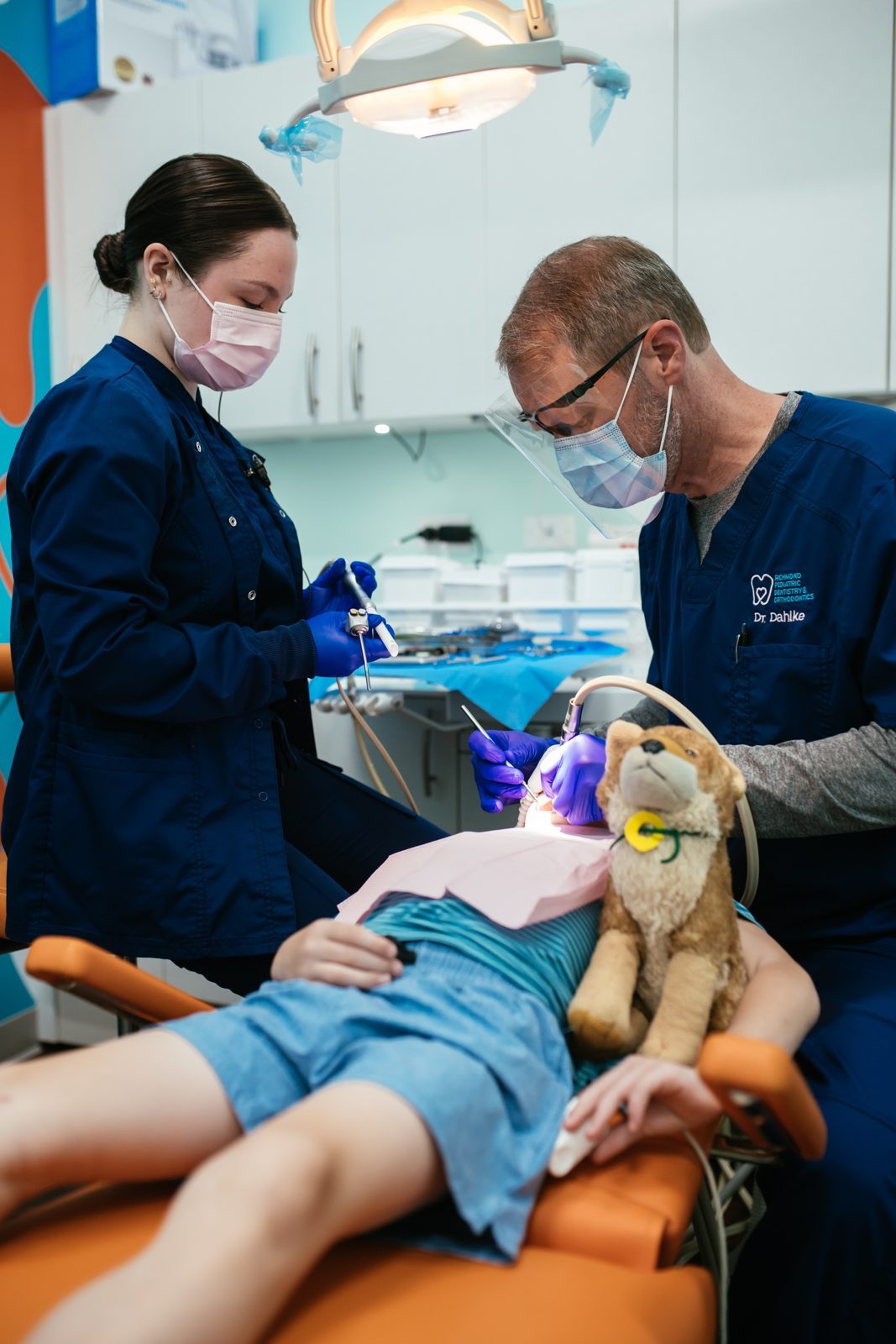
The short answer: Pediatric restorative dentistry is how a pediatric dentist repairs a child’s damaged teeth: tooth-colored fillings for small cavities, crowns for big ones, baby root canals when decay reaches the nerve, and space maintainers when a baby tooth is lost too early. In Richmond, RPDO’s pediatric dentists do this work at four offices. Most repairs are done with numbing alone, and Virginia Medicaid covers them for kids with no cost to the family for covered care.
Pediatric restorative dentistry at RPDO, the quick version
| What we treat | Cavities, cracked or broken baby teeth, teeth with weak or poorly formed enamel, and baby teeth lost too early |
| Treatments | Tooth-colored fillings, stainless steel crowns, white zirconia crowns for front teeth, pulpotomy and pulpectomy (baby root canals), silver diamine fluoride, extractions, space maintainers, and bonding for chipped teeth |
| Who treats your child | Specialty-trained pediatric dentists |
| Comfort options | Numbing, laughing gas, oral sedation and general anesthesia |
| Insurance | Most major dental plans, plus Virginia Medicaid (Cardinal Care Smiles, DentaQuest and Doral) |
| Where in Richmond | Short Pump, the West End (Gaskins Road), Mechanicsville, and Midlothian (pediatric visits on Wednesdays) |
| To book | Request an appointment online or call (804) 741-2226 (Midlothian: (804) 740-7281) |
Does a Baby Tooth Really Need to Be Fixed?
Usually, yes. Baby teeth stay in much longer than most parents expect.
The back baby molars usually stay until about age 10 to 12, and some hang on until 13. A cavity found at age 5 may have to last another five to seven years.
Left alone, a cavity in a baby tooth keeps growing. It can reach the nerve and cause pain, infection and swelling. The American Academy of Pediatric Dentistry (AAPD) links early childhood tooth decay to emergency room visits, missed school days and nutrition problems. An infected baby tooth can also affect the adult tooth forming underneath it.
Baby teeth hold space, too. As the American Dental Association puts it, they’re sometimes called “nature’s braces.” Lose a baby molar years early and the teeth beside it can drift into the gap, leaving less room for the adult tooth coming in behind it.
Not every cavity needs a drill. The AAPD says plainly that not every cavity needs a filling. A very early cavity can sometimes be stopped with fluoride and better brushing, and a cavity in a tooth that’s already loose may not need anything. We’ll tell you which kind your child has, and why.
What a cavity does when it’s left alone
Press play or drag the slider to watch it grow. Then tap See the fix to see how we’d repair it at that stage.
Stage 1 of 5
A chalky white spot
The enamel is losing minerals, but there’s no hole yet.
If we catch it here
Fluoride, sealants and better brushing can stop it.
No numbing, no drilling
A simplified drawing of a baby molar, with the adult tooth forming in the bone underneath it. The deeper the decay goes, the bigger the repair.
How long does that baby tooth have left?
Pick your child’s age and the tooth with the cavity. We’ll show you how long it usually has to last.
Which tooth?
About 5 to 7 more years
A second baby molar usually falls out around ages 10 to 12. A cavity there has a long time to grow, so it’s usually worth fixing.
| Baby tooth | Usually falls out around |
|---|---|
| Front teeth (incisors) | Ages 6 to 8 |
| Canines | Ages 9 to 12 |
| First molars | Ages 9 to 11 |
| Second molars | Ages 10 to 12 |
Typical ages from the American Dental Association. Every child is a little different.
How We Decide What Your Child’s Tooth Needs
A tooth has three layers. How deep the decay goes decides the repair, and the deeper it goes, the bigger the repair.
Enamel
The hard outer shell
A chalky white spot, no hole yet. Fluoride, sealants and closer checkups can often stop it here.
Dentin
The softer layer underneath
A real cavity. A tooth-colored filling for small and medium ones, a crown when it’s big. Silver diamine fluoride can slow it down in a very young child.
Nerve (pulp)
The soft center of the tooth
Decay has reached the nerve. A baby root canal (pulpotomy or pulpectomy), usually followed by a crown. If the tooth can’t be saved, it comes out.
| What we find | What we usually recommend | What’s involved |
|---|---|---|
| A chalky white spot, no hole yet | Fluoride, sealants and closer checkups | No numbing, no drilling |
| An active cavity in a very young or anxious child, or many cavities at once | Silver diamine fluoride to slow things down while we plan the rest | A few minutes, no numbing |
| A small or medium cavity | A tooth-colored filling | Numbing |
| A large cavity, or decay spreading across several sides of a baby molar, especially in a young child with many cavities | Usually a crown | Numbing |
| Decay that has reached a healthy nerve | A pulpotomy, then usually a crown | Numbing |
| A nerve that is infected or has died | A pulpectomy and usually a crown, or removing the tooth | Numbing, sometimes sedation |
| A tooth that can’t be saved | Removing the tooth, then a space maintainer if needed | Numbing, sometimes sedation |
Where a tooth lands on this ladder comes from the exam and X-rays. Ask to see the X-ray. We’re happy to point out what we’re looking at.
Not sure where your child’s tooth lands?
A quick exam and X-rays answer that. You’ll see the X-ray, hear the options in plain words, and know the cost before anything is done.
Tooth-Colored Fillings for Kids
Pediatric dental fillings repair small and medium cavities. We remove the decayed part of the tooth and fill the space with composite, a tooth-colored material that bonds to the tooth and blends in.
What happens at a filling appointment
-
Numbing
A numbing gel goes on the gum first to dull it. Then we give a local anesthetic, so the tooth is numb before we start.
-
A rubber dam
A small rubber sheet fits around the tooth. It keeps the tooth dry so the filling bonds, and keeps water and bits of tooth out of your child’s throat.
-
Cleaning out the decay
We remove the soft, decayed part of the tooth and keep as much healthy tooth as we can.
-
Filling
The composite goes in, a special light hardens it, and we shape it to fit your child’s bite.
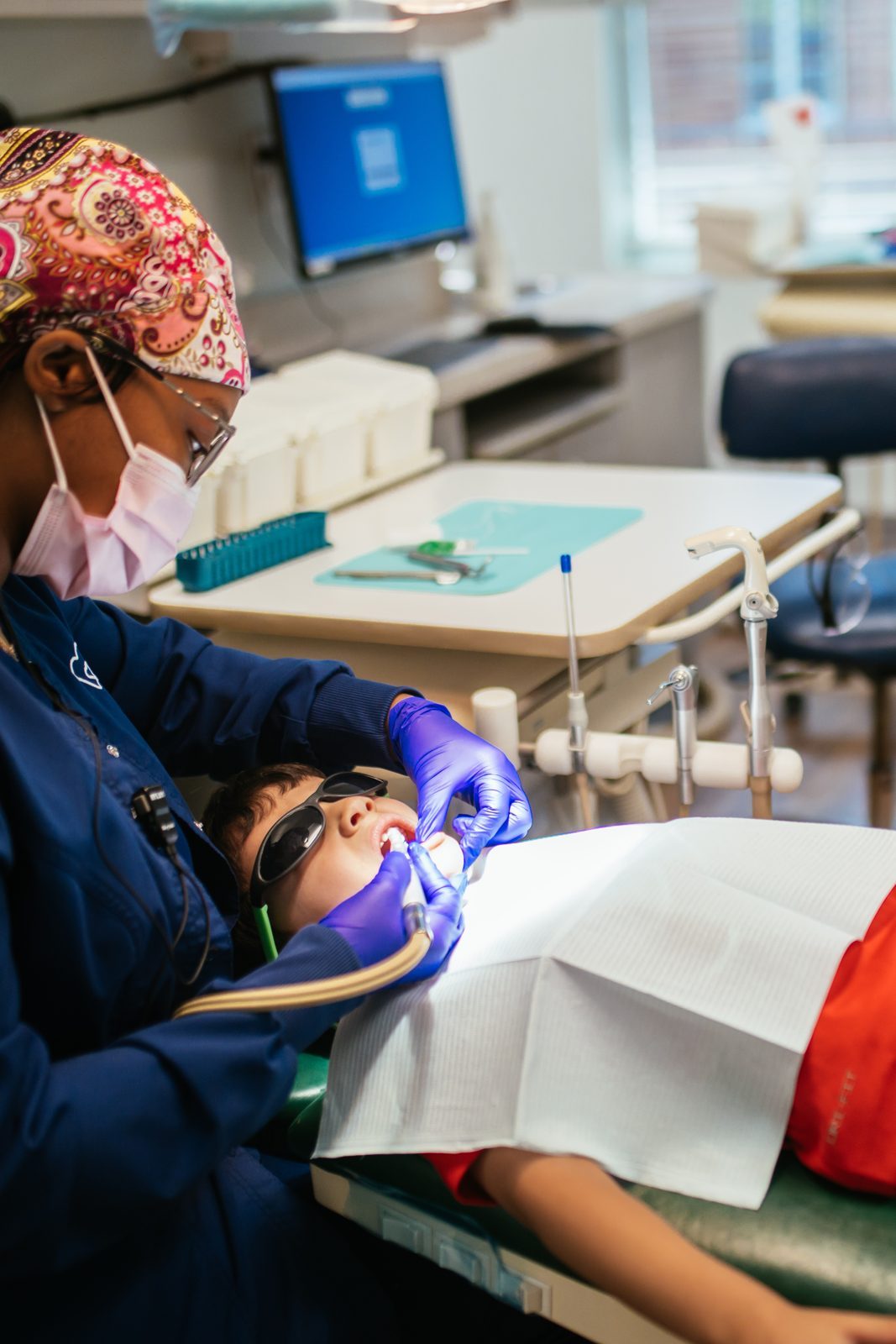
After a filling
Your child can go back to normal activities. The lip, cheek and tongue near the tooth may stay numb for a few hours, so stick to soft foods and skip gum until the feeling comes back.
Flossing matters after any filling, because a new cavity can start at its edge.
Watch for lip biting
Kids often chew or suck on a numb lip or cheek without noticing. In one study of numbing for lower teeth, about 1 in 8 children bit their lip or cheek afterward, and closer to 1 in 5 children under age 4 did.
Fillings in baby teeth don’t always last as long as fillings in adult teeth, and a large filling in a baby molar has a lot of work to do. That’s why, for bigger cavities, we often recommend a crown instead.
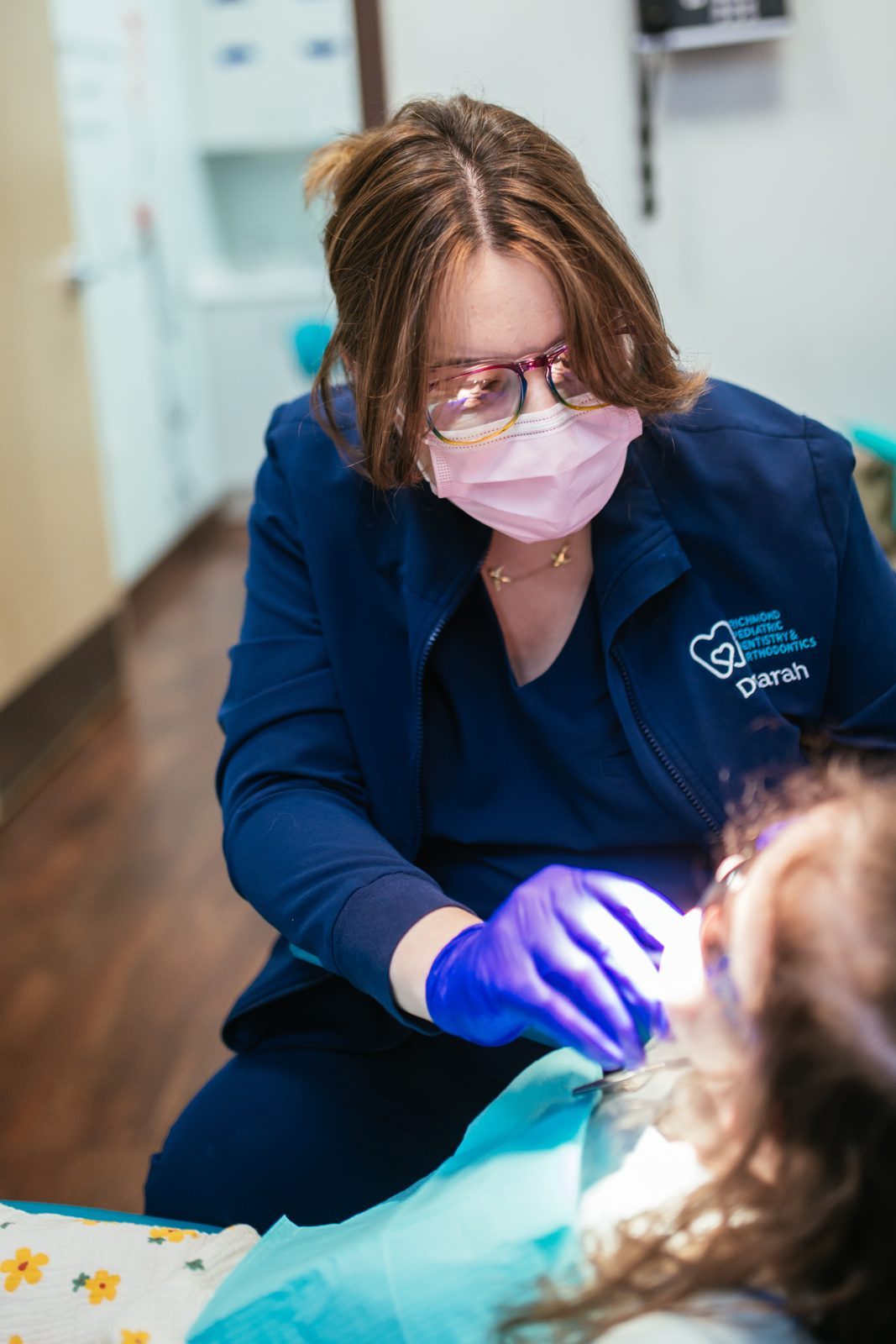
Crowns for Baby Teeth: Silver Caps and White Crowns
Pediatric dental crowns cover the whole tooth when a cavity is too big for a filling. A crown protects what’s left of the tooth until the tooth falls out on its own.
Crowns are also common after a baby root canal, on teeth with weak or poorly formed enamel, and for young children with several cavities. A stainless steel crown is less likely than a filling to need redoing.
A Cochrane review also found that crowns are likely to lower the chance of major failure or pain over time compared with fillings.
Stainless steel crowns, the “silver caps”
If you’ve seen a child with silver teeth, these are the crowns you saw. Pediatric dentists have relied on them for decades. They’re strong, they go on in one visit, and they rarely need to be redone.
They aren’t made in a lab. We numb the tooth, shape it, choose the right size from a set of ready-made crowns, fit it, and cement it in place, all in the same appointment. We use them on back teeth, where they’re hard to see, and occasionally on baby canines.
- The bite may feel different at first. A new crown can feel a little tight. Kids adjust quickly.
- Brush along the gumline, right where the crown meets the gum.
- Metal allergies. Steel crowns contain nickel and chromium, so tell us if your child has a known metal allergy.
White crowns for front teeth
For the front baby teeth, we use white zirconia crowns. Zirconia is a tooth-colored ceramic, so the crown looks much more like a natural tooth. In studies, parents are more satisfied with how zirconia looks than with steel.
In studies of baby teeth, here is how zirconia compares with steel:
- More tooth is removed. A zirconia crown can’t be bent to fit, so the tooth is shaped to fit the crown.
- Gums tend to stay healthier around zirconia than around steel.
- Steel may stay on slightly better, according to the AAPD, though newer studies found little difference.
- Zirconia is very hard. Some studies suggest it can wear down the tooth it bites against.
Which crown or filling fits your child’s tooth?
Stainless steel crown
- Looks
- Silver
- Best for
- Back teeth with large cavities, teeth after a baby root canal, kids with many cavities
- Trade-off
- It shows when your child laughs
White zirconia crown
- Looks
- Tooth-colored
- Best for
- Front baby teeth with large cavities or damage
- Trade-off
- More tooth is removed, and it can’t be adjusted
Tooth-colored filling
- Looks
- Tooth-colored
- Best for
- Small and medium cavities
- Trade-off
- Less durable than a crown for large cavities in baby molars
Holding a treatment plan with crowns on it?
Bring it in. Our pediatric dentists will look at the X-rays with you and walk you through each tooth and why.
Baby Root Canals: Pulpotomy and Pulpectomy
A baby root canal treats a cavity that has reached the nerve, the soft tissue in the center of the tooth. It saves the tooth instead of pulling it.
Signs the nerve may be involved:
- A toothache that wakes your child at night
- Pain that starts on its own, without eating or drinking
- Swelling in the gum or face
Sometimes there are no signs at all, and we find it on an X-ray.
Swelling in the face, especially with a fever, needs to be seen the same day. Call us. After hours, the same number reaches our on-call doctor, who will decide whether your child needs emergent treatment or a referral to an emergency department. Here is what to do in a pediatric dental emergency in Richmond.
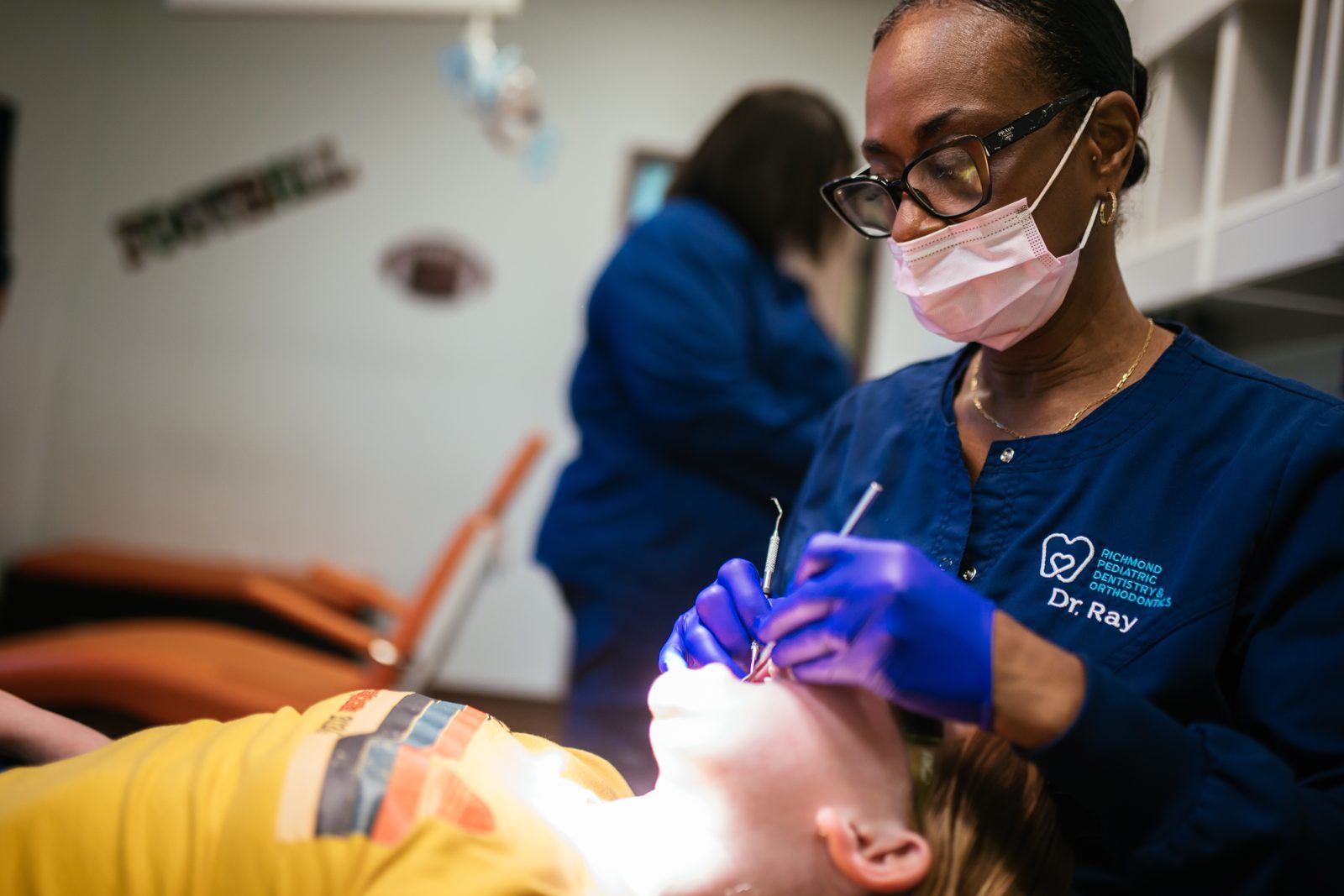
Pulpotomy
When decay reaches the nerve but the nerve is still healthy, we remove the part of the nerve in the crown of the tooth. Then we place a medicated dressing over the healthy nerve in the roots and seal the tooth. Most teeth get a crown afterward to protect them.
Pulpectomy
When the nerve is infected or has died, we clean out all of the nerve tissue, including the roots. Then we fill the canals with a material that dissolves naturally as the adult tooth comes in. A crown usually goes on afterward.
A pulpectomy isn’t always possible. If infection has damaged too much bone or root, removing the tooth is the safer choice.
| Pulpotomy | Pulpectomy | |
|---|---|---|
| Used when | Decay has reached a nerve that is still healthy | The nerve is infected or has died |
| What we remove | The nerve tissue in the top of the tooth | All of the nerve tissue, including the roots |
| What goes in | A medicated dressing, then a seal | A filling material the body absorbs as the adult tooth comes in |
| After | Usually a crown | Usually a crown |
Why not just pull it?
Sometimes that is the right call, and we’ll say so. But pulling a baby molar years early leaves a gap the other teeth can drift into, and it often means a space maintainer.
Saving the tooth keeps chewing normal and holds the space on its own. We’ll check a treated tooth on X-rays at future checkups, because a small number of these teeth need more care later. When a tooth does need to come out, here is how we handle extractions for kids.
Is your child’s tooth hurting right now?
Call the office and tell us it hurts. Pain, swelling or a tooth that wakes your child at night shouldn’t wait for the next checkup.
Silver Diamine Fluoride: Slowing or Stopping a Cavity Without Drilling
Silver diamine fluoride, or SDF, is a liquid we brush onto a cavity. There’s no drilling and no numbing, and it takes a few minutes.
Studies suggest it stops roughly two out of three treated cavities in baby teeth from growing over two years when it’s reapplied once or twice a year. The AAPD says studies have found it works better than fluoride varnish at stopping cavities that are already there.
The trade is color. SDF turns the decayed spot permanently black. The healthy tooth around it stays its normal color.
SDF can make sense for:
- A toddler who is too young to sit through a filling
- A child with many cavities, so we can slow them all down while we treat the worst ones first
- A child with special health care needs
- Any child who needs time before a filling or crown
SDF is only for cavities that haven’t reached the nerve. A tooth that aches on its own needs a different treatment.
It doesn’t rebuild the tooth, and a treated cavity can still be filled later. Most parents are fine with the dark spot on a back tooth. Front teeth are a harder decision, and we’ll talk it through with you. SDF isn’t used for children with a silver allergy.
Space Maintainers When a Baby Tooth Comes Out Early
If a baby molar has to come out years before the adult tooth is ready, a space maintainer holds the gap open so the adult tooth has room to come in. A 2022 review of studies found that the most space is lost in the first three months after a baby molar comes out.
Space maintainers are small, custom-fitted appliances made of steel bands and wire. We cement them to nearby teeth. Two common types:
- Band and loop: holds one space on one side of the mouth
- Bilateral space maintainers: such as a lower holding arch, which holds spaces on both sides of the lower jaw
The appliance stays until the adult tooth comes in, and then we remove it.
To keep it working, skip sticky candy and gum, and don’t let your child push on it with a finger or tongue. If it feels loose, call us. Loose cement is the most common problem, and it’s easier to fix when it’s caught early.
Because our orthodontists are part of the same practice, spacing questions don’t need an outside referral. If a lost tooth or a space maintainer affects how your child’s bite is developing, Dr. Kevin Bibona or Dr. Payton Cook can take a look. Learn more about early orthodontic treatment.
Bonding for Chipped, Stained or Misshapen Teeth
A chipped front tooth, a tooth that grew in misshapen, or a tooth with stained or weak enamel can often be repaired with bonding. We shape tooth-colored composite onto the tooth so it blends in with the teeth around it.
Poorly formed enamel has a name, enamel hypoplasia, and it makes teeth more likely to get cavities. Bonding or a crown can protect those teeth.

Keeping Your Child Comfortable
Many kids do fine with numbing alone, and we take our time getting there.
- Numbing gel first. The gel dulls the gum before the local anesthetic goes in.
- Tell, show, do. We tell your child what’s next in kid-friendly words, show them the tool, and then do it. No surprises.
- Laughing gas. Nitrous oxide helps a nervous child relax. It doesn’t numb the tooth, so we still use numbing with it. It wears off within minutes, and most kids go back to their normal day.
- Oral sedation and general anesthesia. For extensive treatment, very young children, or kids who can’t sit through dental work, sedation lets us finish safely, often in one visit. Read about sedation dentistry for kids in Richmond.
If your child is scared of the dentist, read our guide to dental anxiety in children. Children with autism, sensory differences or medical needs are welcome. See our special needs pediatric dentistry page.
Have a nervous kid?
Tell us when you book. We’ll plan the visit around your child, from tell, show, do to laughing gas or sedation when it’s needed.
Cost, Insurance and Virginia Medicaid
You get the treatment options and the cost before anything is done.
Virginia Medicaid
Virginia Medicaid’s dental program, Cardinal Care Smiles (formerly Smiles For Children), covers medically necessary fillings, crowns, baby root canals, silver diamine fluoride and space maintainers for children. Coverage runs through age 20 for children with Medicaid or FAMIS Plus, and through age 18 with FAMIS.
When your child is enrolled and the care is covered, there is no cost to you. The program’s provider manual lists tooth-colored crowns for baby teeth as covered, along with stainless steel crowns.
We accept Cardinal Care Smiles, DentaQuest and Doral at all four pediatric offices. Learn more about our pediatric dentist that accepts Medicaid in Richmond.
Private insurance and payment plans
We accept most major dental insurance plans, except DMO/DHMO plans and discount programs. Most plans cover part of the cost of fillings and crowns, and your share depends on your plan.
We also offer flexible financing. See our insurance information page for details.
Get your child’s tooth looked at this month
A cavity is usually easier to treat when it’s caught early. Medicaid and most major dental plans accepted at all four pediatric offices.
What Richmond parents say
Real Google reviews from families across our Richmond-area offices
Kids’ Fillings and Crowns at Four Richmond-Area Offices
Fillings, crowns and baby root canals happen at our four pediatric offices. Our Patterson Avenue office is orthodontics only, so families near Patterson usually go to the West End office on Gaskins Road, a few minutes away.

Short Pump
Near Innsbrook, Wyndham, and Glen Allen
12270 W Broad St, Richmond, VA 23233
Mon to Thu 8 a.m. to 5 p.m., Fri 8 a.m. to 1 p.m.

West End
Pediatric dentistry only
Near Tuckahoe, Gayton, and Ridgefield Parkway
2560 Gaskins Rd, Richmond, VA 23238
Mon to Thu 8 a.m. to 5 p.m., Fri 8 a.m. to 1 p.m.

Mechanicsville
Serving Atlee, Rural Point, Old Church, and Hanover County
7521 Right Flank Rd #110, Mechanicsville, VA 23116
Mon to Thu 8 a.m. to 5 p.m., Fri 8 a.m. to 1 p.m.

Midlothian
Kids’ dentistry on Wednesdays
Near Brandermill, Woodlake, and Bon Air
13901 Coalfield Commons Pl, Suite 101, Midlothian, VA 23114
Pediatric dentistry Wednesdays, 8 a.m. to 5 p.m.
Families come to us from Henrico, Glen Allen, Tuckahoe, Chesterfield, Hanover, and across RVA. Not sure which office is closest? Call (804) 741-2226 and we’ll help you pick.
Who Treats Your Child
Every restorative visit is with a pediatric dentist. That’s a dentist with at least two more years of specialty training after dental school, focused only on children.
Dr. Bill Dahlke, DMD, has practiced pediatric dentistry for 20 years. He has served three terms as president of the Virginia Academy of Pediatric Dentistry, was named a 2025 Virginia Living Top Dentist, and has hospital affiliations with Children’s Hospital of Richmond at VCU and VCU Medical Center.





Questions Parents Ask About Fillings, Crowns and Baby Root Canals
Straight answers to what Richmond families ask us most.
Do baby teeth with crowns fall out on their own?
Yes. A crown stays on the baby tooth until the tooth loosens on its normal schedule, and then the crown comes out with it. Nothing has to be removed separately.
If the adult tooth is coming in and the crowned baby tooth isn’t budging, we check it the same way we would any stubborn baby tooth.
Why do kids get silver caps on their teeth?
Kids get silver caps, which are stainless steel crowns, when a cavity in a baby molar is too big for a filling, after a baby root canal, or when a young child has several cavities and needs repairs that are less likely to need redoing. They’re strong, go on in one visit, and usually last until the tooth falls out.
Do silver caps have mercury in them?
No. Silver caps are stainless steel crowns, made of steel with nickel and chromium. They’re a different thing from the old silver (amalgam) fillings.
Tell us if your child has a metal allergy.
How much do fillings and crowns cost for kids?
With Virginia Medicaid (Cardinal Care Smiles), covered fillings, crowns, baby root canals and space maintainers cost your family nothing.
With private insurance, most plans cover part of the cost, and your share depends on your plan. Our front desk can check your benefits, and you get the treatment options and the cost before anything is done.
Is my child too young for a filling or crown?
There’s no minimum age. Toddlers can get fillings and crowns when a cavity needs one.
For children 4 and under with larger cavities, crowns usually hold up better than fillings. Very young children who can’t sit through treatment may do better with silver diamine fluoride for now, or with sedation.
Does my child really need a crown on a baby tooth?
Crowns on baby teeth are common, especially on back molars. If the cavity is large or spread across several sides of a baby molar, a crown usually holds up better than a filling.
If the tooth is close to falling out, we may suggest something smaller, or nothing at all.
Is a pulpotomy the same as a root canal?
Not quite. A pulpotomy removes only the nerve tissue in the top part of the tooth and leaves the healthy nerve in the roots. A pulpectomy removes all of it, which is closer to an adult root canal.
Both are often called baby root canals, and both are usually followed by a crown.
Does getting a filling or crown hurt?
The tooth is numbed first, so your child should feel pressure and vibration, not pain. Numbing gel goes on the gum before the local anesthetic, and laughing gas can help a nervous child relax.
Afterward, the area may feel a little tender, and a new crown can feel tight for a few days.
Can my child get a filling without being sedated?
Yes. Many fillings are done with numbing alone, and laughing gas is available for kids who need help relaxing. Laughing gas doesn’t numb the tooth, so numbing is still used with it.
Sedation is for extensive treatment or kids who can’t sit through dental work.
Can you fix all of my child’s cavities in one visit?
It depends on how many teeth need work and how your child does in the chair. Some kids have everything done in one visit. Others do better with a few shorter visits.
For extensive treatment, sedation or general anesthesia can let us finish everything at once. We’ll lay out the options.
Does the black stain from silver diamine fluoride go away?
No. The treated spot stays dark for as long as the tooth is in the mouth, and brushing won’t remove it. If the stain bothers your child later, the tooth can often be covered with a filling or crown once the cavity is under control.
Is silver diamine fluoride safe for kids?
The AAPD considers SDF safe for children when it’s used according to dosing guidelines. It isn’t used for kids with a silver allergy. Side effects can include a metallic taste and temporary staining if it touches the skin, which fades within about two weeks.
Can my child get braces with silver caps?
Yes. Crowns on baby teeth don’t rule out braces or other orthodontic treatment. Your child’s orthodontist will plan around any crowned teeth, and RPDO’s pediatric dentists and orthodontists work in the same practice.
Can a tooth still get a cavity under a silver cap?
It’s uncommon. A crown covers the whole tooth, which is why it protects against new decay better than a filling does.
Decay can start if a crown comes loose or plaque builds up where the crown meets the gum, so we check crowned teeth at every checkup.
Will a baby root canal hurt the adult tooth coming in?
It shouldn’t. The material used in a baby root canal is meant to come out with the baby tooth, or to dissolve along with its roots, so the adult tooth can come in normally.
An infection left untreated can affect the adult tooth forming underneath, which is one reason we treat it.
Why see a pediatric dentist for fillings instead of a family dentist?
Pediatric dentists spend at least two more years training after dental school, focused only on children. That includes fillings and crowns on baby teeth, numbing small mouths, helping nervous kids through treatment, and sedation when it’s needed.
What if a crown, filling or space maintainer comes off?
Call the office that treated your child. If a crown comes off, keep it and bring it with you.
A loose space maintainer should be seen soon, before it bends or comes out completely. For a problem after hours, see our guide for a pediatric dental emergency in Richmond.
Does Medicaid cover crowns and baby root canals for kids?
Yes, when they’re medically necessary. Cardinal Care Smiles covers fillings, crowns on baby teeth, baby root canals, silver diamine fluoride and space maintainers, with no cost to families for covered care.
RPDO accepts Cardinal Care Smiles, DentaQuest and Doral at all four pediatric offices.
Can silver caps be replaced with white crowns later?
Usually there’s no reason to. A stainless steel crown stays until the baby tooth falls out. If a crown on a visible tooth bothers your child, ask about it at a checkup and we’ll tell you whether a change makes sense.
Should I get a second opinion?
If a treatment plan surprised you, it’s reasonable to ask for one, and we’re glad to be that second look. Bring the X-rays if you have them. We’ll look at it with fresh eyes and walk you through what we see and why.
Fillings, crowns and baby root canals for kids
Get Your Child’s Tooth Taken Care Of
Picture the drive home: the tooth fixed, the numbness wearing off, and a plan you understand for the rest of your child’s teeth. Our pediatric dentists in Short Pump, the West End, Mechanicsville and Midlothian will explain the options in plain words and help you pick the one that fits your child.
Sources
- Oral Health Tips for Children, Centers for Disease Control and Prevention
- Primary Tooth Development chart, American Dental Association
- Baby Teeth, American Dental Association
- Pediatric Restorative Dentistry, American Academy of Pediatric Dentistry
- Pulp Therapy for Primary and Immature Permanent Teeth, American Academy of Pediatric Dentistry
- Use of Vital Pulp Therapies in Primary Teeth, American Academy of Pediatric Dentistry, 2024
- Use of Silver Diamine Fluoride for Dental Caries Management in Children and Adolescents, Including Those with Special Health Care Needs, American Academy of Pediatric Dentistry
- Management of the Developing Dentition and Occlusion, American Academy of Pediatric Dentistry
- Early Childhood Caries: Consequences and Preventive Strategies, American Academy of Pediatric Dentistry
- Preformed crowns for decayed primary molar teeth, Cochrane Database of Systematic Reviews, 2015
- Bilateral versus unilateral mandibular block anesthesia in a pediatric population, Pediatric Dentistry, 2000
- Short- and long-term dental arch spatial changes following premature loss of primary molars: A systematic review, Journal of Indian Society of Pedodontics and Preventive Dentistry, 2022
- Cardinal Care Smiles Dental Benefits Booklet, Virginia Department of Medical Assistance Services
- Cardinal Care Smiles Office Reference Manual, DentaQuest, 2026
