Underbite is the one bite problem where your child’s age changes the answer.
Crooked teeth at eight and crooked teeth at eighteen are the same problem with the same fix. An underbite at eight and an underbite at eighteen can be two different conditions calling for two different kinds of intervention, and only one of them may involve an operating room.
So when parents come to our offices looking for underbite correction in Richmond or asking whether their child’s underbite will need surgery, we cannot answer from a photo. We need two things: how much of the underbite is coming from the jaws rather than the teeth, and how much growing your child has left.
Dr. Kevin Bibona and Dr. Payton Cook treat underbite at four offices across the Richmond metro. What you will not get from them is a treatment plan before records, or a conversation about surgery before we have checked whether growth can still do that work for us.
What Is an Underbite?
An underbite is what happens when the lower front teeth sit in front of the upper front teeth instead of behind them. Orthodontists call it a Class III malocclusion. Some call it mandibular prognathism.
In a healthy bite, the upper front teeth overlap the lower ones slightly. That overlap lets the back teeth meet properly when the mouth closes. An underbite reverses that relationship, and the whole bite has to compensate.
Roughly 5% to 10% of people have an underbite, according to the Cleveland Clinic, ranging from slight misalignment that never needs treatment to significant misalignment that does.
Not every underbite is the same problem, though, and this distinction drives every decision that follows.
Two underbites, two different problems
They can look the same in a photo. What is happening underneath is not the same, and it changes everything that follows.
Dental underbiteThe teeth are the problem
- What is happening
- The jaws are the right size and in the right place. A few front teeth have tipped the wrong way.
- How we find it
- X-rays show a normal jaw relationship behind an abnormal-looking bite.
- Typical treatment
- Braces or clear aligners, often on their own.
- Typical timeline
- Roughly 12 to 24 months in a single phase.
- How much does age matter
- Less. Teeth can be moved at almost any age, which is why adults do well here too.
Skeletal underbiteThe jaws are the problem
- What is happening
- The jaws themselves are mismatched. The upper jaw may be underdeveloped, the lower jaw may be growing forward, or both.
- How we find it
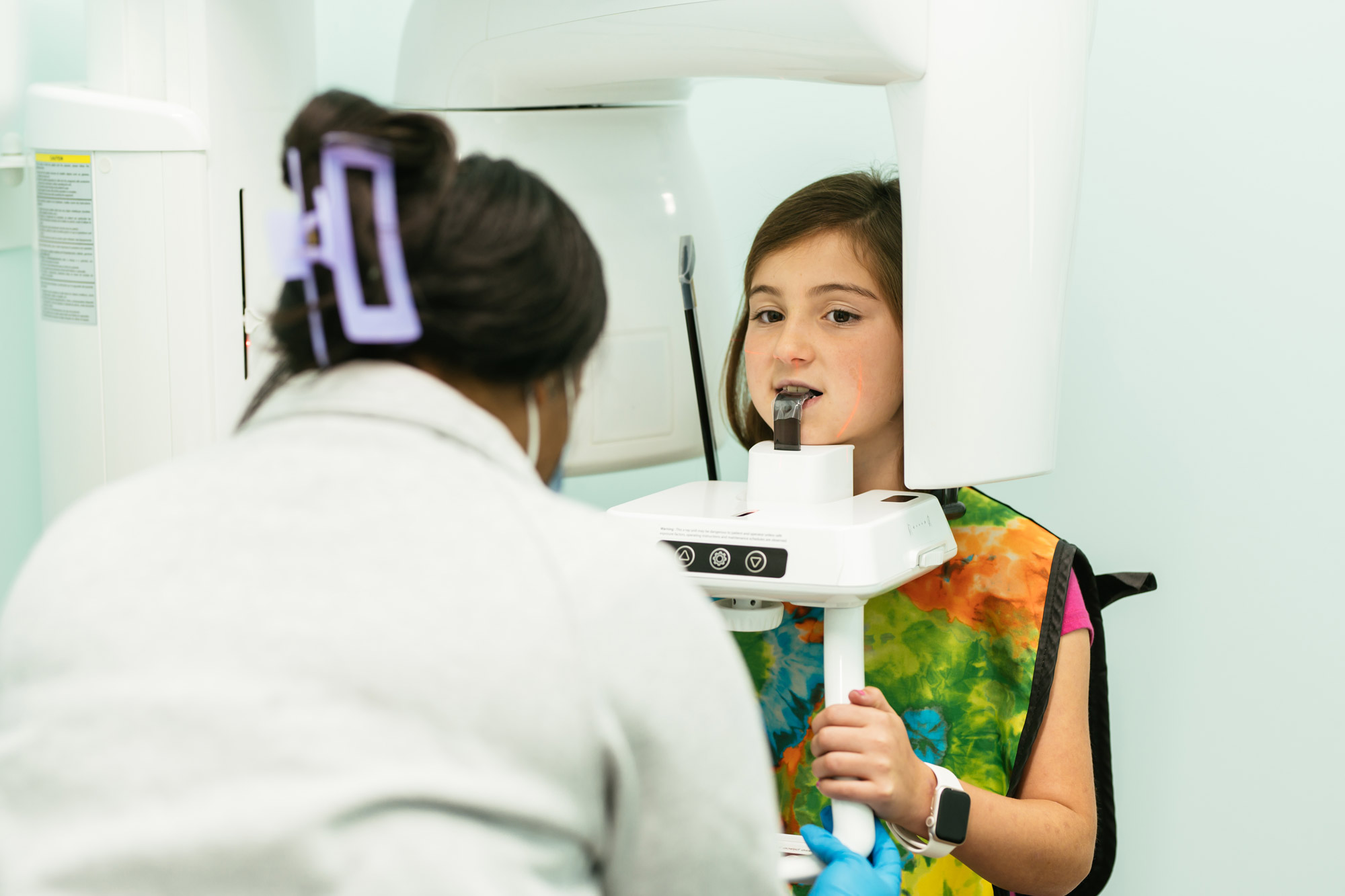
- X-rays and 3D imaging measure the actual jaw relationship, not just tooth position.
- Typical treatment
- Appliance therapy to influence jaw growth, then braces. Facemask or expander is common.
- Typical timeline
- Often two phases separated by a monitoring period while your child grows.
- How much does age matter
- A great deal. Growth modification options close as your child finishes growing.
Plenty of underbites are a mix of both. Sorting out the proportion is the first thing we do at an evaluation, because the answer sets the timeline.
Signs Your Child May Have an Underbite
Some underbites are obvious. Others hide until a specific tooth erupts or the jaw hits a growth spurt. And sometimes the first clue is not clinical at all, just a child who has started covering their mouth in photos.
Does this sound like your child?
Underbites show up differently in different kids. These are the things parents tell us they noticed first.
- Their bottom teeth sit in front of the top ones when their mouth is closed
- Their chin looks like it juts forward, especially in profile
- They struggle to bite into sandwiches, apples, or pizza
- They chew mostly on one side
- Certain sounds have not cleared up on their own
- They snore, breathe through their mouth, or sleep restlessly
- Someone else in the family has the same bite
If two or more of these sound familiar, an evaluation will tell you whether it is dental, skeletal, or nothing to act on yet.
Book a free evaluationWhat can happen if an underbite goes untreated
A mild underbite may never cause symptoms or need treatment. A significant one is a different situation, because the mechanical problem tends to create others over time.
- Uneven tooth wear. Teeth meeting at wrong angles grind against each other and wear down enamel that does not grow back.
- Jaw joint strain. A bite that does not close properly forces the jaw muscles and joints to compensate. Over years, that can contribute to TMJ pain, headaches, and jaw clicking.
- Difficulty chewing. A bite that does not meet properly makes some foods harder to bite into and chew.
- Speech. In some children, bite relationships contribute to difficulty producing certain sounds. An evaluation can help determine whether dental structure is part of the picture.
- Airway and sleep. When an underdeveloped or narrow upper jaw shows up alongside mouth breathing, snoring, or restless sleep, airway factors may deserve a closer look. That is when we also evaluate for airway orthodontics.
- A harder problem later. This is the one that matters most. Some skeletal underbites become more pronounced as the lower jaw keeps growing, and the non surgical options narrow as that happens.
Underbites in babies and toddlers
Parents of very young children ask about this constantly, and the honest answer is reassuring: a reversed bite in a toddler with baby teeth does not always mean a lifelong underbite. Jaws move a lot during those years.
What we do want to know about is family history and habits. Prolonged thumb sucking, pacifier use past age three, bottle use past age one, and tongue thrusting all place repeated pressure on developing jaws. So does an inherited jaw pattern, which is the most common cause of all.
If an underbite runs in your family, mention it at your child’s pediatric dental visit. We will start watching earlier.
Underbite Treatment Options
Treatment depends on which type of underbite your child has, how significant it is, and how much growing they have left.
Reverse pull facemask
For a child whose upper jaw is underdeveloped, a facemask applies gentle forward traction to bring the upper jaw into a better position. It is typically worn at home and overnight rather than at school. Facemask therapy is among the better supported non surgical approaches for a growing child with an underdeveloped upper jaw, and it depends on that jaw still being responsive to growth.
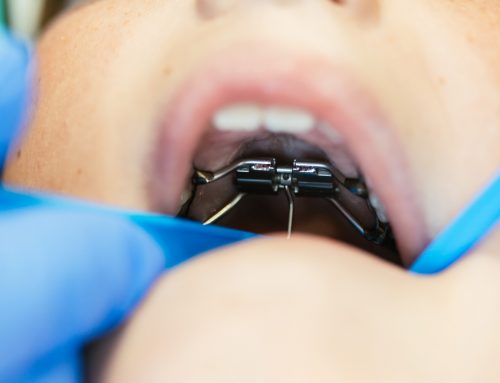
Palatal expander
An expander widens a narrow upper jaw. It is often paired with a facemask, since a wider upper arch gives the corrected bite somewhere stable to land. Many skeletal underbites in children involve a narrow upper jaw as well as a forward lower jaw.
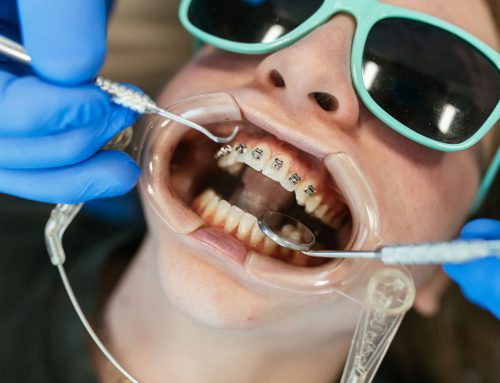
Braces
Braces do the detailed work of moving individual teeth into their corrected positions. For a dental underbite, braces alone may be the whole treatment. For a skeletal underbite, braces usually follow the appliance phase, often with elastics that fine tune the bite relationship.
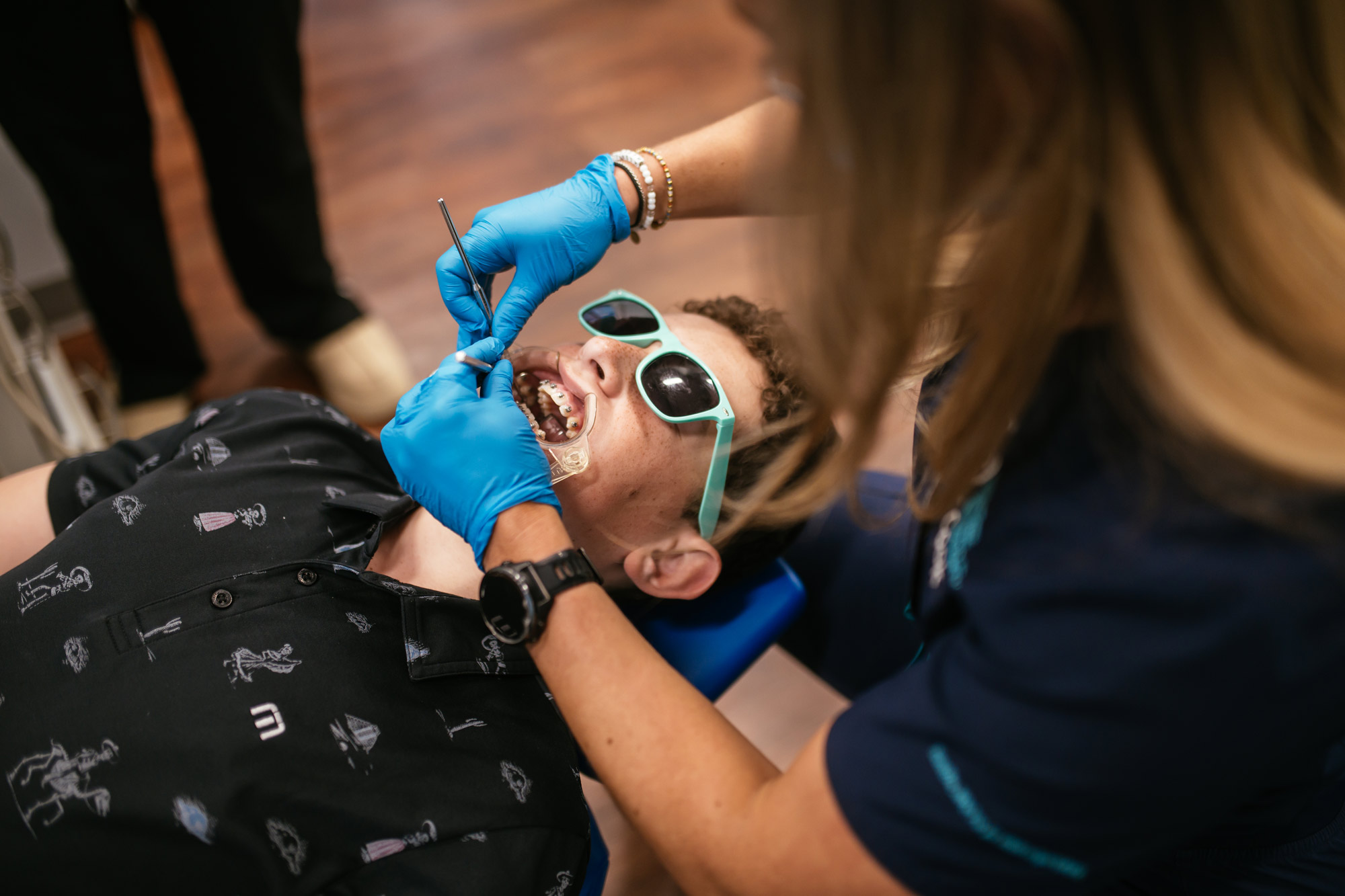
Clear aligners
Clear aligners can correct mild to moderate dental underbites, and aligner systems for younger children have improved considerably. They are a poor fit for significant skeletal mismatches. We will tell you plainly whether your child is a candidate rather than selling you the treatment you came in hoping for.
Tooth extraction
When crowding is contributing to the bite, removing selected teeth creates the room needed to reposition the rest. This is sometimes a first step rather than a treatment on its own.
Two phase treatment
Many underbites are handled with Phase 1 treatment during the mixed dentition years to guide jaw growth, followed by a shorter second phase with braces once the permanent teeth are in. Understanding the stages of orthodontic treatment for children helps set expectations for what that timeline looks like.
Jaw surgery
For adults, and for teens whose growth has finished with a significant skeletal underbite remaining, orthognathic surgery combined with orthodontics may be the most predictable path to a stable bite. We coordinate with oral and maxillofacial surgeons in the Richmond area when that is the right call.
We want to be straight with you about this: surgery is a legitimate and successful treatment, and some cases need it. Our point is not that surgery is bad. Our point is that early evaluation is often what determines whether it enters the conversation at all.
When Should Underbite Treatment Begin?
Underbite is the bite problem where timing matters most. Here is how the window works.
Age 7: the recommended age for a first orthodontic evaluation
The American Association of Orthodontists recommends every child have an orthodontic evaluation by age seven. By then the first permanent molars and incisors have come in, which lets us see how the jaws relate to each other.
For most bite issues, age seven is about catching things early. For underbite, that evaluation carries extra weight, because the treatment options that depend on growth are the same ones that can keep surgery off the table. An evaluation at seven costs you nothing at our offices.
Ages 7 to 10: an important early treatment period
For many children with a developing skeletal underbite, these years give the orthodontist options that depend on active jaw growth. The upper jaw sutures are still responsive, and appliances like a reverse pull facemask or expander can influence how the jaws develop rather than only moving teeth around within them.
That does not mean every seven year old with an underbite needs treatment right away. The point of the evaluation is to determine whether treatment should begin now or whether the better plan is to watch growth and revisit.
The teen years
Treatment is still very possible. Dental underbites correct well with braces or aligners in teens. Skeletal underbites become harder as growth slows, and the lower jaw is often the last thing to finish growing, sometimes not until the late teens for boys.
If your teen has an underbite, get evaluated now rather than waiting. Knowing where they are in their growth changes the options on the table.
Adults
Adults can absolutely have underbites treated. Adult orthodontics can correct dental underbites and improve moderate ones. For significant skeletal underbites in adults, the conversation usually includes surgery, because the jaws no longer respond to growth modification.
Where is your child in the timing window?
Three questions. It will not diagnose anything, but it will tell you how urgent an evaluation is.
This is a guide to timing, not a diagnosis. Only an exam with X-rays can tell you whether an underbite is dental, skeletal, or both.
Correcting an Underbite Without Surgery
This is the question parents actually come in with, so we will answer it directly.
Whether an underbite can be corrected without surgery comes down to three factors: how much of the problem is skeletal versus dental, how severe the skeletal component is, and how much growth your child has left.
An eight year old with a moderate skeletal underbite and years of growth ahead may have growth modification options on the table: a facemask, an expander, braces. The same underbite at twenty five is usually a surgical conversation, because the thing that made those options possible, growth, is gone. No one can promise you an outcome before seeing records. What we can tell you is that the range of available options is different at those two ages.
That is the entire argument for early evaluation, and it is why we would rather see your child at seven and tell you nothing needs to happen yet than see them at fifteen and have fewer options to offer.
-
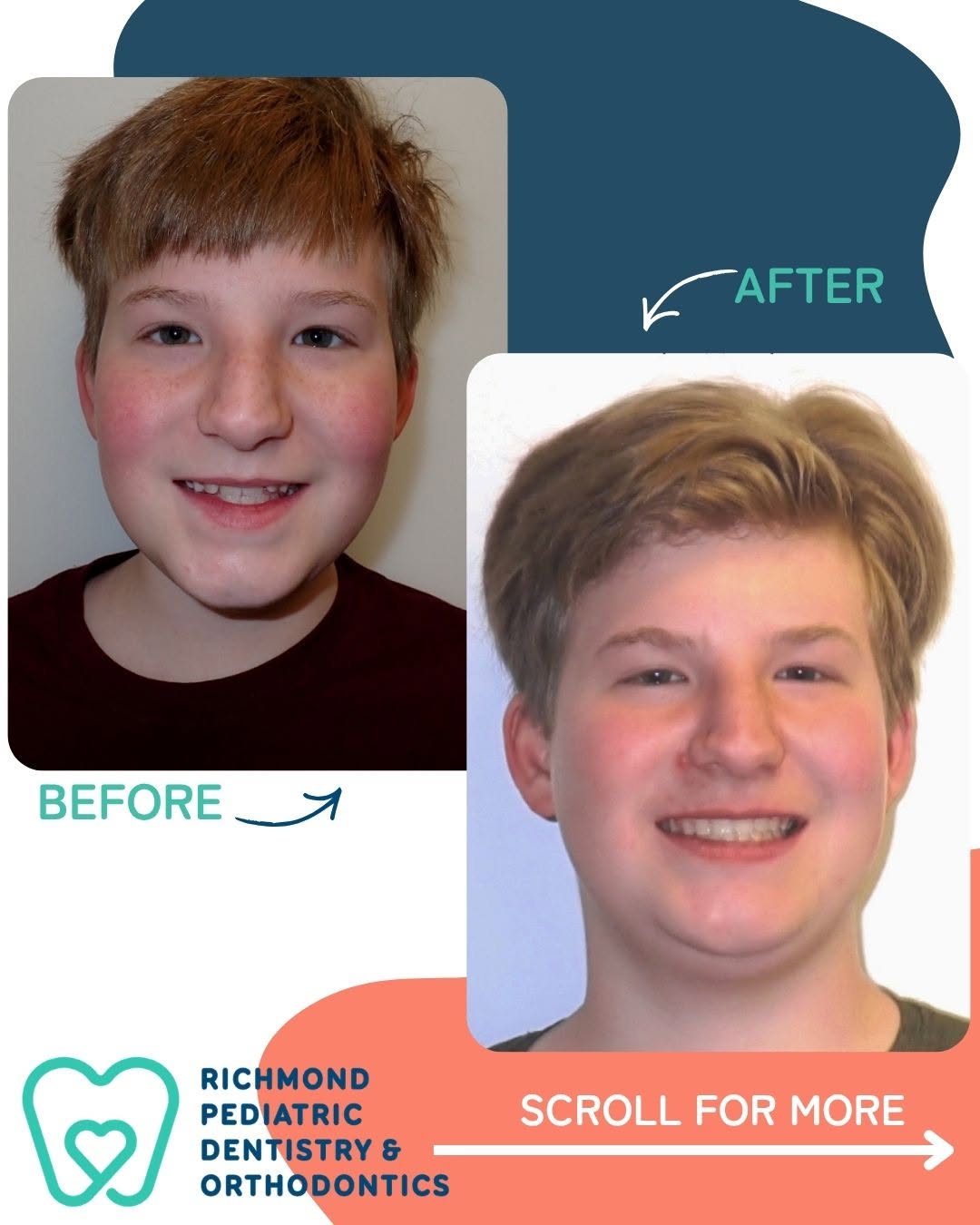 The full smile, before treatment and after.
-
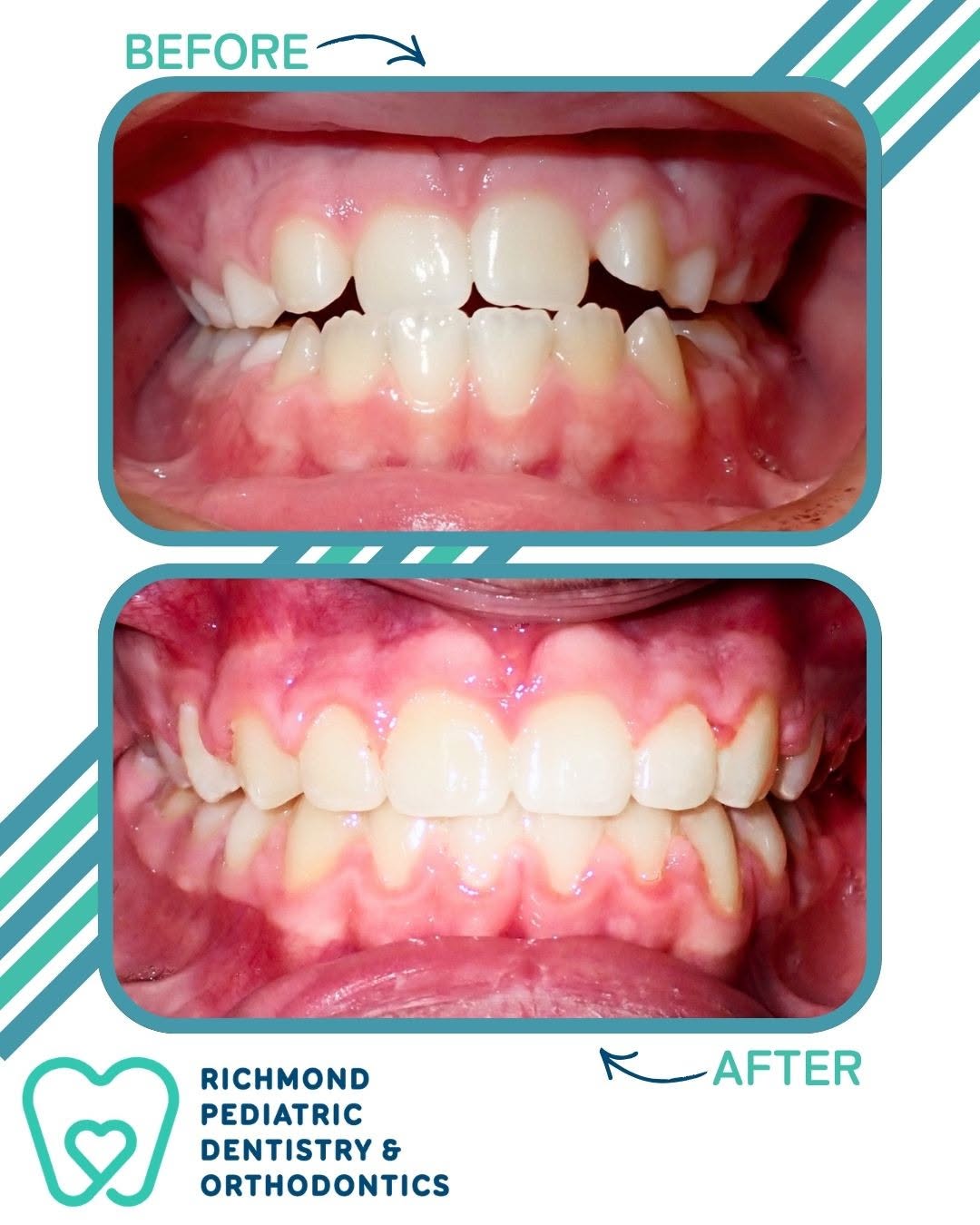 The bite up close. Alignment and spacing corrected with the expander and braces.
-
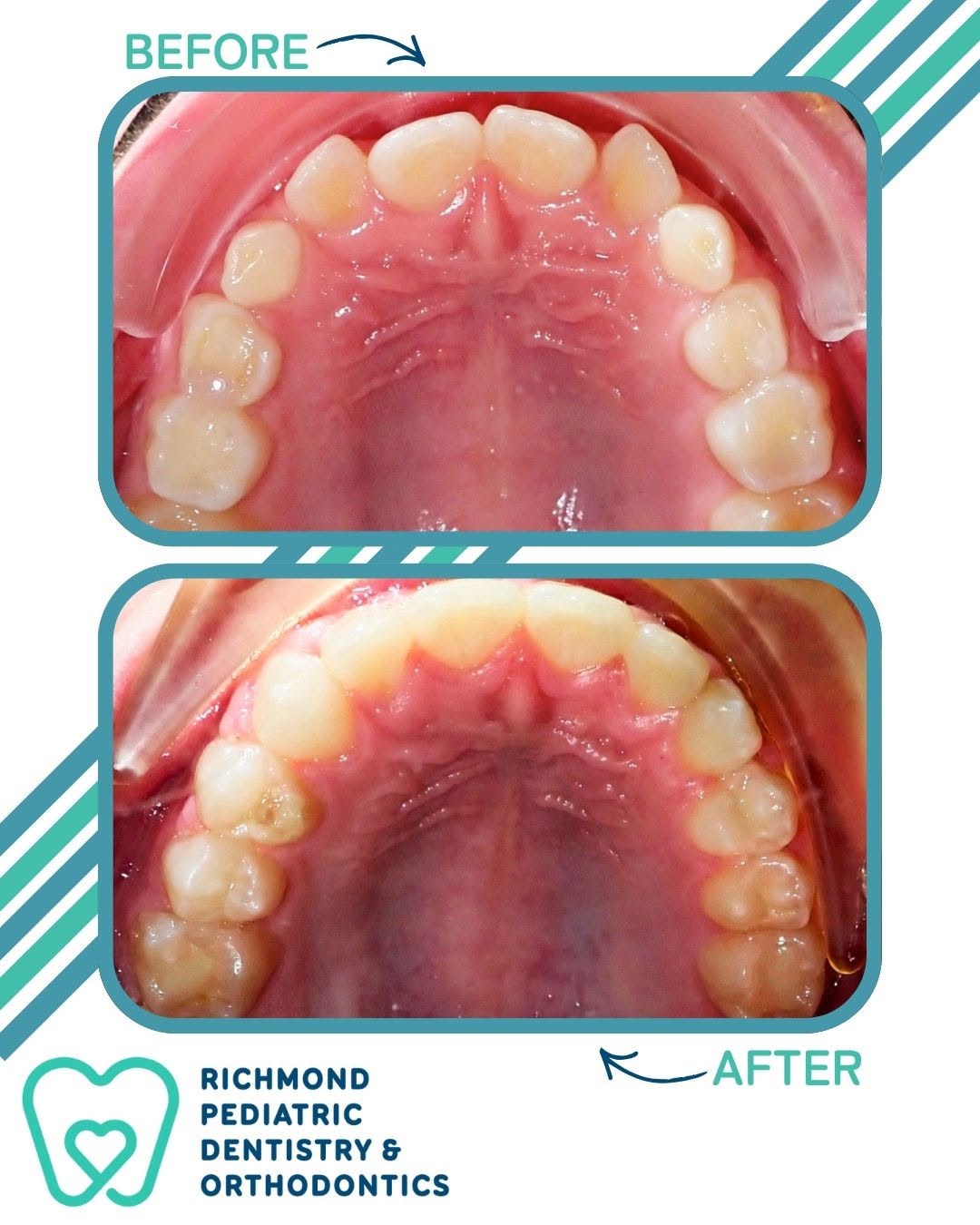 The upper arch. A narrow palate widened with the rapid palatal expander.
William came to us with three things happening at once: an underbite, a narrow upper jaw, and crowding. His family arrived with one clear ask. Fix it without surgery if there was any way to do that.
There was, because he still had growing left to do. The plan ran in three stages.
- Make room. Retained baby canines were blocking his permanent teeth from coming in properly. We referred him out to have those removed.
- Widen the upper jaw. A rapid palatal expander gradually widened the narrow upper arch. For an underbite, this is the step that does the heavy lifting, and it only works while the jaw is still responsive to growth.
- Finish the bite. Upper and lower braces with elastics moved the individual teeth into their corrected positions.
A full, healthy, aligned bite. No jaw surgery.
What made William's case work was not the appliance. It was the timing. The same underbite, caught after his growth had finished, would have been a very different conversation.
Shared with patient permission. Individual results vary, and treatment recommendations depend on each patient's records, diagnosis, and remaining growth. Originally shared on our Facebook page.
What to Expect at Your Underbite Consultation
Your first visit is complimentary, and there is no obligation attached to it. What to expect at your consultation covers the full visit, and here is the short version.
What the first visit actually looks like
About an hour, no cost, and no one asks you to decide anything that day.
Our Richmond Orthodontic Team
Underbite correction, particularly the skeletal kind, is among the more demanding things an orthodontist treats. It requires reading growth correctly and knowing when to intervene.
Dr. Kevin Bibona is a specialty-trained orthodontist, Past President of the Richmond Dental Society, a member of the American Association of Orthodontists, and a 2025 Virginia Living Top Dentist. Dr. Payton Cook rounds out our orthodontic team. Meet our orthodontists to read their full backgrounds.
Because we are a bi-specialty practice, our orthodontists and pediatric dentists work in the same practice and share records. If your child's underbite involves crowding, early extractions, or an airway question, the two specialties coordinate directly rather than sending you across town with a referral slip.
Richmond-Area Locations Offering Underbite Treatment
Our orthodontists see patients at four offices across the Greater Richmond metro.
Where we treat underbite
Our orthodontists see patients at four offices across the Richmond metro. Tap a location to see it on the map.
How Much Does Underbite Correction Cost in Richmond?
Comprehensive orthodontic treatment in the Greater Richmond area generally runs between $3,000 and $7,000, and underbite correction falls inside that range. Where a specific case lands depends on whether it is dental or skeletal, whether appliance therapy is needed before braces, and whether treatment is one phase or two.
Two phase treatment for a skeletal underbite typically costs more overall than single phase treatment, though the phases are separated by years and paid separately.
We will not quote you a number before we have looked at your child's records, because a number given without a diagnosis behind it is not worth much.
Making it affordable
- Most dental plans with orthodontic benefits cover a portion of underbite treatment, and coverage is often stronger when treatment is documented as medically necessary rather than cosmetic. Our team verifies your insurance benefits before treatment starts.
- Flexible financing with monthly payment plans, no interest options available.
- HSA and FSA funds can be applied to orthodontic treatment.
- Your written estimate comes out of the free consultation, so you can compare before deciding.
Why Richmond Families Choose RPDO for Underbite Correction
Both specialties in one practice. Pediatric dentistry and orthodontics share records and coordinate care, which matters for underbite cases involving extractions or airway questions.
Specialty-trained orthodontists with modern diagnostics. Additional years of training beyond dental school in growth and jaw development, plus the digital imaging and 3D scanning that skeletal diagnosis depends on.
Over 100 years in Richmond, privately owned. Generations of families across Henrico, Chesterfield, and Hanover counties. Recommendations come from our orthodontists, not a regional quota.
Recognized locally. Featured by Richmond Times-Dispatch, Style Weekly Magazine, Virginia Living Magazine, and Richmond Magazine.
An office kids do not dread. Underbite treatment can span years. The experience has to work for your child, not just the clinical plan.
Read what families have said in our patient testimonials, or browse the smile gallery to see results.
What Richmond families say
Unedited Google reviews from parents across our Richmond-area offices.
Other Bite Issues We Treat in Richmond
Underbite rarely shows up alone. If you are not certain what is going on with your child's bite, one consultation covers all of it.
- Crossbite correction for upper teeth sitting inside the lower teeth
- Overjet treatment for upper front teeth that protrude forward
- Open bite treatment for front teeth that do not meet when the back teeth close
- Crooked teeth treatment for crowding and alignment
- Airway orthodontics for bite issues connected to breathing and sleep
- Early orthodontic treatment for guiding jaw growth in young children
Underbite Correction FAQs
Can an underbite correct itself?
A significant underbite does not correct itself. Occasionally a reversed bite in a toddler with baby teeth resolves as the jaws grow, but a skeletal underbite can become more pronounced over time as the lower jaw continues to grow. Waiting to see usually means fewer options later, not more.
Can an underbite be fixed without surgery?
Often, yes, when the child is still growing. Appliances like a reverse pull facemask and palatal expander can influence jaw development while the bones are still responsive, followed by braces to finish the bite. In adults with significant skeletal underbites, jaw surgery is often needed because growth modification is no longer possible. Which situation applies to your child depends on the type and severity of the underbite and how much growth remains.
What age should an underbite be treated?
The American Association of Orthodontists recommends a first orthodontic evaluation by age seven, and for underbite that recommendation carries extra weight. Ages seven to ten is an important early treatment period, because the upper jaw is still growing and can respond to appliances. Not every child evaluated at seven needs treatment at seven.
How long does underbite treatment take?
A dental underbite corrected with braces alone commonly takes twelve to twenty four months. A skeletal underbite treated in two phases involves several months to a year of appliance therapy, a monitoring period while your child grows, then a second phase with braces. Your orthodontist will give you a specific timeline at your consultation.
Is an underbite the same as an anterior crossbite?
They overlap but are not identical. An anterior crossbite describes one or more upper front teeth biting behind the lower front teeth. Underbite is the broader term for a Class III bite relationship, and it may come from the position of the teeth, the jaws, or both. Sorting out whether the problem is dental or skeletal is one of the first things we do at your evaluation, because treatment and timing differ substantially between the two.
Does an underbite cause health problems?
It can. Untreated underbites are associated with uneven tooth wear, jaw joint strain and TMJ symptoms, difficulty chewing, speech difficulties, and in cases involving an underdeveloped upper jaw, a narrower airway that can affect breathing and sleep quality.
Does insurance cover underbite treatment?
Most dental plans with orthodontic benefits cover a portion, and underbite cases are often well documented as medically necessary, which can improve coverage compared with treatment sought purely for appearance. Coverage varies widely by plan. Our team verifies your specific benefits and tells you your out of pocket cost before treatment begins.
Can adults get an underbite corrected?
Yes. Mild to moderate dental underbites in adults respond well to braces or clear aligners. Significant skeletal underbites in adults generally require orthognathic surgery paired with orthodontics, because the jaws no longer respond to growth modification. Either way, an evaluation will tell you which situation you are in.
Schedule Your Free Underbite Consultation in Richmond
If your child has an underbite, the most useful thing you can do this month is find out what kind it is and how much growth is left.
Find out which kind of underbite you are dealing with
The visit is free, it takes about an hour, and you leave knowing whether you are looking at an appliance, braces, a wait and watch plan, or a surgical conversation years down the road. Most families are relieved by what they hear.