Medically reviewed by Bill Dahlke, DMD, Pediatric Dentist
If your child cries, clings, or refuses to open their mouth at the dentist, you are not doing anything wrong, and you are far from alone. Dental anxiety in children is one of the most common reasons Richmond, VA parents call our offices, and it is also one of the most fixable. With the right preparation at home and a pediatric team that knows how to work with nervous kids, most children go from dreading the dental chair to handling it just fine.
This guide walks you through why the fear happens, what to try before and during the visit, and how our pediatric dentists across Short Pump, West End, Mechanicsville, and Midlothian help anxious kids feel safe.
Dental anxiety in children is fear, nervousness, or distress connected to visiting the dentist or receiving dental treatment. It can range from mild jitters before an appointment to intense fear that prevents a child from getting the care they need.
What Causes Dental Anxiety in Children?
Fear of the dentist rarely comes from one thing. For most kids it builds out of a few overlapping causes:
- Fear of the unknown. A new room, bright lights, unfamiliar sounds, and a stranger looking inside their mouth is a lot for a small person to process.
- A past experience. One uncomfortable cleaning, a rushed visit, or a procedure that hurt can stick with a child long after it is over.
- Picking up on a parent’s nerves. Kids read us closely. If the dentist makes you anxious, your child often senses it before a word is spoken.
- Sensory sensitivity. Bright overhead lights, the vibration and whir of equipment, the texture of gloves and toothpaste, unfamiliar smells, and the feeling of hands in their mouth can overwhelm a sensitive child. For many anxious kids, sensory processing differences sit underneath the fear.
- Fear of pain. Older children sometimes arrive already worried it will hurt, often from something they heard from a sibling, a friend, or a movie.
Studies in the pediatric dental literature estimate that roughly one in ten children and teens, about 9%, experience dental fear strong enough to interfere with their care, though estimates vary with age and how anxiety is measured. It tends to peak in toddlers and early elementary years, then ease as kids gain experience. That last part matters: anxiety usually shrinks the more positive visits a child has, which is why early, regular care does so much of the heavy lifting.
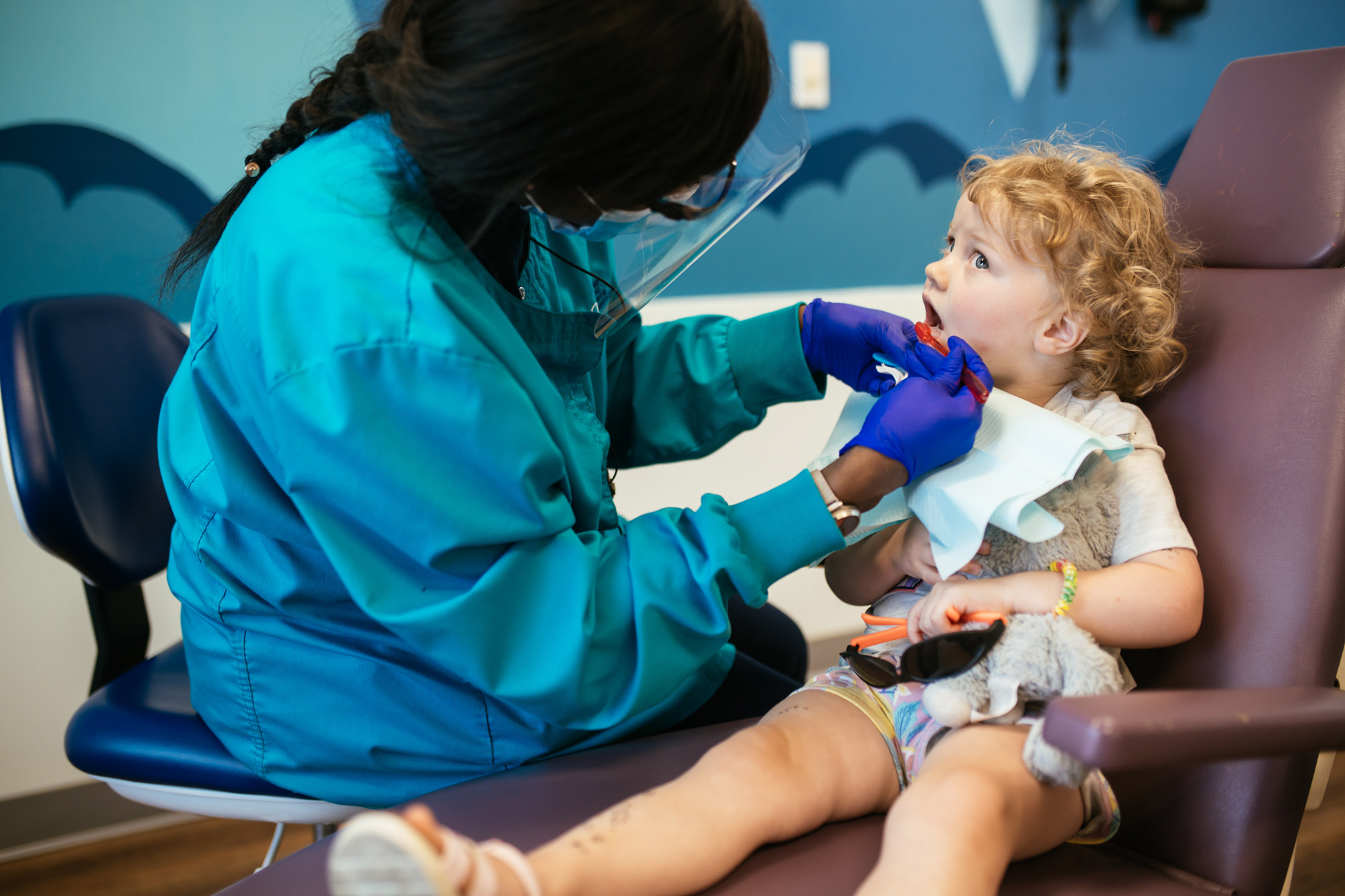
Signs Your Child May Be Anxious About the Dentist
Kids do not always say “I’m scared.” Anxiety often shows up in behavior and in the body instead. Watch for:
- Stalling, hiding, or flat-out refusing to leave for the appointment
- Crying, clinging, or sudden clinginess in the days before a visit
- Complaints of a stomachache, headache, or feeling sick the morning of
- Trouble sleeping the night before
- Going quiet and withdrawn, or the opposite, getting loud and combative
- Refusing to open their mouth or sit in the chair once they arrive
Spotting these early gives you time to prepare, which is where most of the progress happens.
Does this sound like your child?
If two or more of these look familiar, dental anxiety is likely part of what is going on.
- Stalling, hiding, or flat-out refusing to leave for the appointment
- Crying, clinging, or sudden clinginess in the days before a visit
- Complaints of a stomachache, headache, or feeling sick the morning of
- Trouble sleeping the night before
- Going quiet and withdrawn, or the opposite, getting loud and combative
- Refusing to open their mouth or sit in the chair once they arrive
Tell us before you come in. We will note it in the chart and slow the visit down from the first hello.
Book a visit at your child’s paceHow to Prepare an Anxious Child Before the Visit
The visit is half-won at home. A few simple habits in the days beforehand make a real difference.
Choose your words carefully. Skip “shot,” “drill,” “hurt,” and “pain,” even in a sentence meant to reassure. Telling a child “it won’t hurt” plants the idea that it might. Try friendly framing instead: the dentist counts your teeth and checks for sugar bugs, and the cleaning makes your smile shiny and strong.
Keep your own feelings out of it. If dental visits stress you, do your best not to broadcast it. Let a calmer partner handle the prep talk if that helps.
Read books and watch videos. Stories and short clips of favorite characters going to the dentist show your child what to expect in a format that feels safe and familiar.
Play dentist at home. Let your child be the dentist and “count” a stuffed animal’s teeth with a toothbrush, then switch. Practicing opening wide turns the real thing into something they have already rehearsed.
Never use the dentist as a threat. “If you don’t brush, you’ll need a filling” links dental care to punishment and fuels the exact fear you are trying to prevent.
Pick the right time of day. Younger and more anxious kids usually do best with a morning appointment, when they are rested and the office is quieter than the busy after-school rush.
Call ahead. Let our team know your child gets nervous before you arrive. A few notes in the chart help us slow down and tailor the visit from the first hello.
Starting care early helps more than anything. The American Academy of Pediatric Dentistry recommends a first dental visit by age one or when the first tooth appears, and children who begin early and keep a regular schedule tend to report less fear later. If you are booking that first appointment, our guide to your child’s first visit walks you through exactly what happens.
Starting early is the best fix there is
The sooner the office feels familiar, the less room fear has to grow. First visits with us are short, gentle, and mostly about saying hello.
Schedule your child’s first visitMedicaid accepted at all four pediatric locations
What Not to Do When Your Child Is Afraid of the Dentist
A few well-meant moves tend to backfire. If you have a child afraid of the dentist, steer clear of these:
- Do not spring the appointment on them.A surprise takes away their chance to prepare and can feel like a trap.
- Do not promise “nothing will hurt.”It plants doubt and breaks trust if anything ever feels uncomfortable.
- Do not use the dentist as a threat or punishment.It ties dental care to fear.
- Do not pass along your own dental nerves.Kids pick up on a parent’s worry fast.
- Do not cancel routine visits because of the fear.Skipping care tends to make the next visit harder, not easier.
What Helps a Child With Dental Anxiety During the Visit
Once you are in the chair, a handful of in-the-moment tools keep anxiety from taking over.
- Bring a comfort item. A favorite stuffed animal, blanket, or fidget toy gives your child something familiar to hold.
- Let them have a job. Holding the suction cup or picking a toothpaste flavor gives a child a sense of control, which is the opposite of how anxiety feels.
- Use a stop signal. Agree on a raised hand that means “I need a break.” Knowing they can pause the visit often means they never need to.
- Distraction works. Music, a show, or a ceiling-mounted screen pulls attention away from the procedure.
- Praise effort, not perfection. Afterward, celebrate how brave they were and what they did well. Skip bribing with candy before the visit, which only signals that something scary is coming.
The 3-3-3 Rule for Anxious Moments
Many Richmond parents ask about the 3-3-3 rule, a quick grounding trick that works well in the dental chair. When your child starts to spiral, walk them through it: name three things they can see in the room, name three sounds they can hear, then wiggle three parts of their body, like toes, fingers, and shoulders. It pulls a worried mind back to the present in under a minute. Practice it at home a few times first so it feels automatic when nerves hit. Pair it with slow “blow out the candle” breaths and it becomes an even stronger reset.
How Pediatric Dentists Help Children With Dental Anxiety
A pediatric dentist is not a general dentist who happens to see kids. After dental school, pediatric specialists complete additional years of training focused specifically on children, including child development and how to work with a fearful patient. That training shows up in everything from the layout of the office to the words used at the chair.
Our specialty-trained team leans on proven behavior management techniques that keep visits calm:
- Tell-Show-Do. We explain each step in kid-friendly language, show the tool on a finger or a model, then do it, so nothing is a surprise.
- Positive reinforcement. Specific praise (“you are doing a great job keeping your mouth open”) builds confidence in real time.
- Modeling. A nervous younger sibling often relaxes after watching an older child sail through their turn.
- Pacing and breaks. We read body language, slow down when a child needs it, and let them reset.
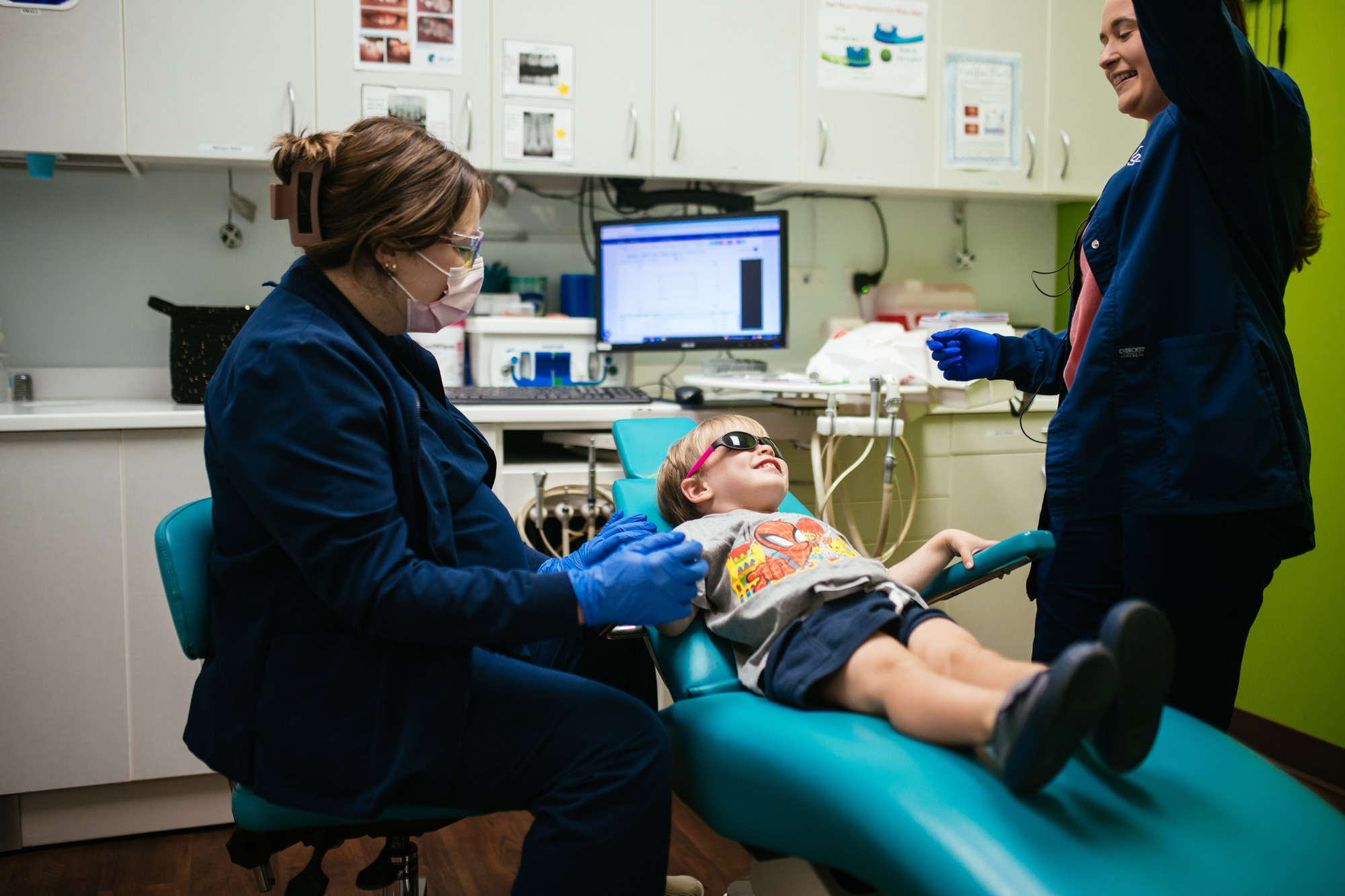
The office itself works in a child’s favor, with a friendlier waiting area, smaller language, and staff who do this every day. For children with sensory needs or developmental differences, our approach to dental care for children with special needs adapts further, with extra time, a calmer setup, and a plan built around your child.
In our own offices, helping an anxious child usually starts before any treatment begins. Small adjustments like these, paired with a team that treats nervous kids every day, are often the difference between a meltdown and a high-five on the way out.
What usually helps, and when
Different situations call for different tools. Here is how the approach maps to what your child is feeling.
What would help your child most?
Three quick questions. You will get a starting point you can bring to your first visit.
How does your child usually react to a dental visit?
Has your child been to a dentist before?
Do you know of any dental work they need?
This is general guidance, not a diagnosis. Your child’s dentist will tailor the plan in person.
What Richmond Parents of Anxious Kids Say
Families across the Richmond area come to us for help with their kids' dental anxiety. Here is what a few of them shared.
Verified reviews from RPDO families on Google.
"We have a child who is very anxious going to the dentist and this team is so wonderful and patient with him every time. We couldn't be happier with our experience. All of the employees are wonderful and the team environment amongst them is felt by all. Amazing place to bring your kids!"
"Well decorated with an under the sea theme, which made the environment cheery and bright. A positive experience for my granddaughter, as she is very anxious going to the dentist. She actually liked it here!"
"Today we had Kristy, who made my shy and slightly nervous daughter actually have fun at the dentist, and hardly even notice she was getting her teeth cleaned. Dr. Yi was so sweet and informative as well. I'm so appreciative of them making both my child and myself feel comfortable and confident in their care!"
More reviews from RPDO families
Live from our Google profiles across the Richmond area.
Is There Medication for a Child's Dental Anxiety?
For most kids, preparation and gentle technique are enough. When a child is very anxious, very young, or needs more involved treatment, sedation options can keep care comfortable and safe.
- Nitrous oxide (laughing gas) is the mildest and most common. It helps a child relax while staying awake and alert, and it wears off within minutes of the mask coming off. It suits mild to moderate anxiety and shorter visits.
- Oral conscious sedation may help for longer or more complex care, keeping an anxious child calm and cooperative.
- General anesthesia, generally provided in a hospital or surgical setting, is reserved for young children with extensive treatment needs, children who cannot safely cooperate, or kids with certain medical or developmental conditions.
Safety guides every level. A child's vital signs are monitored throughout sedation, the plan is matched to your child's age and health history, and some children are not candidates for in-office sedation, which is exactly what we screen for ahead of time. Deeper sedation comes with pre-visit instructions, including fasting guidelines, that we review with you in advance. We start with the least involved option that will work and only step up when a child needs more.
Hospital access matters here too. Dr. Bill Dahlke holds privileges at Children's Hospital of Richmond and VCU Medical Center. For a severely anxious child, a very young child with significant needs, or a medically complex child, that means treatment can be completed safely in a hospital setting by a dentist who already knows your family, rather than handing your child off to someone new.
What About Fear That It Will Hurt?
Fear of pain is one of the biggest drivers of dental anxiety, especially in older kids. Honesty helps more than empty promises here. Routine cleanings and exams are not painful, and that is worth telling your child plainly. When a procedure does call for numbing, we use a topical gel before anything else and keep a child in control with a stop signal. Most kids discover the worry was bigger than the visit, and that single realization makes the next appointment dramatically easier.
When to Worry About Your Child's Dental Anxiety
Some nerves before the dentist are normal and tend to fade with experience. It may be worth a closer conversation if your child's anxiety is severe, gets worse rather than better over time, shows up around many situations beyond the dentist, or causes lasting distress, trouble sleeping, or physical symptoms. In those cases, talk with your pediatric dentist and your child's doctor about the best next steps. Sometimes a slower, step-by-step plan is all that is needed. Sometimes a broader look at anxiety with your pediatrician is the right move. Either way, you have options, and avoiding care is not one you have to settle for.
Choosing a Pediatric Dentist for an Anxious Child in the Richmond Area
Choosing the right pediatric dentist for an anxious child often makes the biggest difference, as much as anything you do at home. Look for a true pediatric office with staff who manage anxious kids daily, a comfortable kid-focused environment, and a team willing to go at your child's pace. Our guide on how to choose a pediatric dentist breaks down what to look for, and you can see how we approach gentle care on our pediatric dentistry page.
Four pediatric locations across the Richmond metro
We welcome anxious kids at every one. Medicaid accepted at all four.
Short Pump
12270 W Broad St, Richmond, VA 23233
Near Short Pump Town Center, serving West Broad Street and the I-64 corridor
West End
2560 Gaskins Rd, Richmond, VA 23238
On Gaskins Road, convenient to Tuckahoe and the near West End
Mechanicsville
7521 Right Flank Rd #110, Mechanicsville, VA 23116
Convenient to Hanover County and the I-295 area
Midlothian
13901 Coalfield Commons Pl, Suite 101, Midlothian, VA 23114
Serving Chesterfield County and the Coalfield area
Cost should never be the reason an anxious child goes without care. We accept Medicaid at all four pediatric locations, so families using Medicaid for pediatric dental care can get the same gentle, unhurried visits as everyone else.
Can Dental Anxiety in Children Be Prevented?
A lot of dental fear is preventable, and the playbook is simple. Start visits early, by age one, so the office feels familiar before fear has a chance to set in. Keep checkups on a regular schedule, since routine visits feel far less high-stakes than rare ones. Praise specific wins, like sitting in the chair, opening wide, or simply trying, rather than a vague "be good," which is how kids respond best. Never use the dentist as a threat, and keep your own nerves in check.
Seeing the same familiar pediatric team over time builds the kind of trust that keeps anxiety low. Solid oral hygiene habits at home help too, because fewer cavities mean fewer involved procedures down the road.
Frequently Asked Questions
Is it normal for kids to cry or scream at the dentist?
Yes, especially with toddlers and young children. Crying, squirming, and refusing to open up are common reactions to a new and overwhelming setting, and pediatric teams see it every day. Staying calm and not scolding your child helps far more than reacting. With experience, most kids settle, and the screaming visits become a phase you look back on rather than a permanent pattern.
At what age should an anxious child first see the dentist?
The American Academy of Pediatric Dentistry recommends a first visit by age one or within six months of the first tooth. Starting early is one of the best ways to prevent dental anxiety in children, because the office, the chair, and the team all become familiar before fear has a chance to take hold. If your child is older and has not been yet, the sooner you start, the easier it tends to be.
What is the 3-3-3 rule and can it help at the dentist?
The 3-3-3 rule is a grounding technique: name three things you can see, three things you can hear, then move three parts of your body. It shifts an anxious mind back to the present in under a minute, which makes it useful right in the dental chair. Practice it with your child during calm moments at home so it feels natural when they actually need it.
Is there medication to help a child with dental anxiety?
Yes. The most common option is nitrous oxide, or laughing gas, a mild sedative that helps a child relax while staying awake and wears off quickly. For more involved care, oral sedation may be appropriate. We always start with the least involved option and discuss the plan with you before any visit.
How can I help if my child is scared the dentist will hurt?
Be honest rather than promising it will not hurt at all. Explain that cleanings and check-ups do not hurt, and that if anything ever feels uncomfortable they can raise their hand to pause. Avoid scary words like "shot" or "drill," and keep your own tone relaxed. When numbing is needed, we use a topical gel first and let your child stay in control throughout.
What if my child has special needs along with dental anxiety?
We tailor visits for children with sensory, developmental, or behavioral needs, with extra time, a calmer environment, and a plan built around your child. You can learn more on our page about dental care for children with special needs, and a quick phone call before the visit helps us prepare.
Can I stay with my child during the appointment?
Policies vary by office and by the type of visit. Younger children often feel calmer with a parent close by during the exam, while some kids cooperate better when the dental team guides them one-on-one. Tell us your preference and we will find the approach that works best for your child.
When should I worry about my child's dental anxiety?
Mild nerves are normal and usually fade. Reach out for more support if the anxiety is severe, keeps getting worse, shows up across many situations beyond the dentist, or causes ongoing distress or physical symptoms. Your pediatric dentist and your child's doctor can help you build a step-by-step plan.
About the Reviewer

Bill Dahlke, DMD
Medical reviewer
- Specialty-trained pediatric dentist
- 20 years with kids
- Hospital affiliations
- 3x VAPD president
- 2025 Virginia Living Top Dentist
Dr. Dahlke is a specialty-trained pediatric dentist at Richmond Pediatric Dentistry & Orthodontics with 20 years of experience caring for children, many of whom arrive anxious. He earned his Doctor of Dental Medicine and completed his pediatric dentistry residency at the University of Nevada, Las Vegas, School of Dental Medicine. Dr. Dahlke holds hospital affiliations with Children's Hospital of Richmond and VCU Medical Center, is a member of the American Academy of Pediatric Dentistry, and has served three terms as president of the Virginia Academy of Pediatric Dentistry. He was named a 2025 Virginia Living Magazine Top Dentist in the pediatric dentistry category. Dr. Dahlke reviewed this article for clinical accuracy.
Read Dr. Dahlke's full bioHelp Your Child Build a Lifetime of Comfortable Dental Visits
Dental anxiety in children is common, and it responds well to the right approach. A little preparation at home, the right words, and a pediatric team that goes at your child's pace can turn a dreaded appointment into a routine one.
If you are looking for a pediatric dentist experienced with anxious children anywhere in the Richmond area, our specialty-trained team across Short Pump, West End, Mechanicsville, and Midlothian is here to help your child feel safe in the chair.
Your child does not have to dread the dentist
Tell us your child gets nervous when you book. We will slow the visit down, take it at their pace, and start building the kind of trust that lasts.
Request an appointment- Four pediatric locations
- Medicaid accepted
- Specialty-trained team