
babies through teenagers
Teeth Cleaning for Kids in Richmond, VA
You already know how this goes. You booked the cleaning, and somewhere between the parking lot and the front desk you started rehearsing your explanation.
The stretch where brushing fell apart. The molar you have been avoiding looking at. The eighteen months that went by faster than they should have.
So before you walk in: we are not going to lecture you about it.
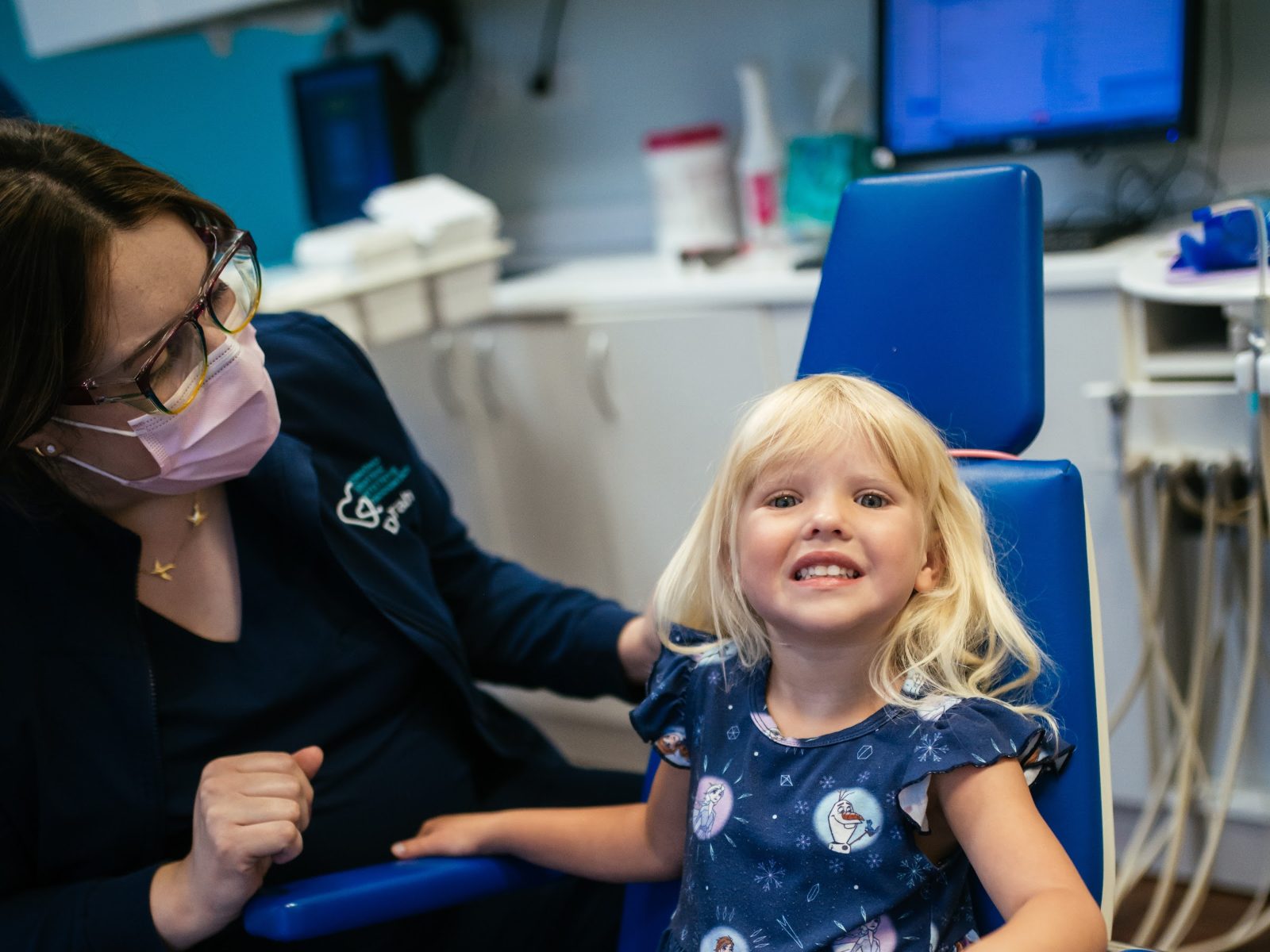
Your child gets their teeth cleaned. You get a straight answer about what we found. You leave knowing what happens next, and no one makes you feel like a bad parent on the way out.
That is the whole visit.
We do pediatric teeth cleanings all day, every day, at four offices around Richmond. Babies through teenagers, first visits through braces.
Your child's cleaning visit at a glance
- A cleaning sized to your child's age, from a soft toothbrush polish for a toddler to a thorough plaque and tartar removal for an older child or teen
- An exam by a pediatric dentist, covering every tooth plus gums, tongue, and how the bite is developing
- Fluoride varnish at the end, if you want it
- X-rays only when there is something an exam cannot see
- A plain explanation of anything we find, and what to do about it
- No comment about how long it has been
four or five parts, start to finish
What does a teeth cleaning for kids include?
A children's dental cleaning at any of our Richmond offices is not one procedure. It is a visit with four or five parts, and no one ever walks you through them.
- A hygienist removes the soft plaque and the hardened deposits brushing cannot reach.
- She polishes the teeth with a soft rubber cup and a gritty paste, which most kids end up liking.
- She flosses between the teeth that touch.
- A pediatric dentist examines every tooth, plus the gums, tongue, bite, and jaw development.
- If you want it, fluoride varnish goes on at the end.
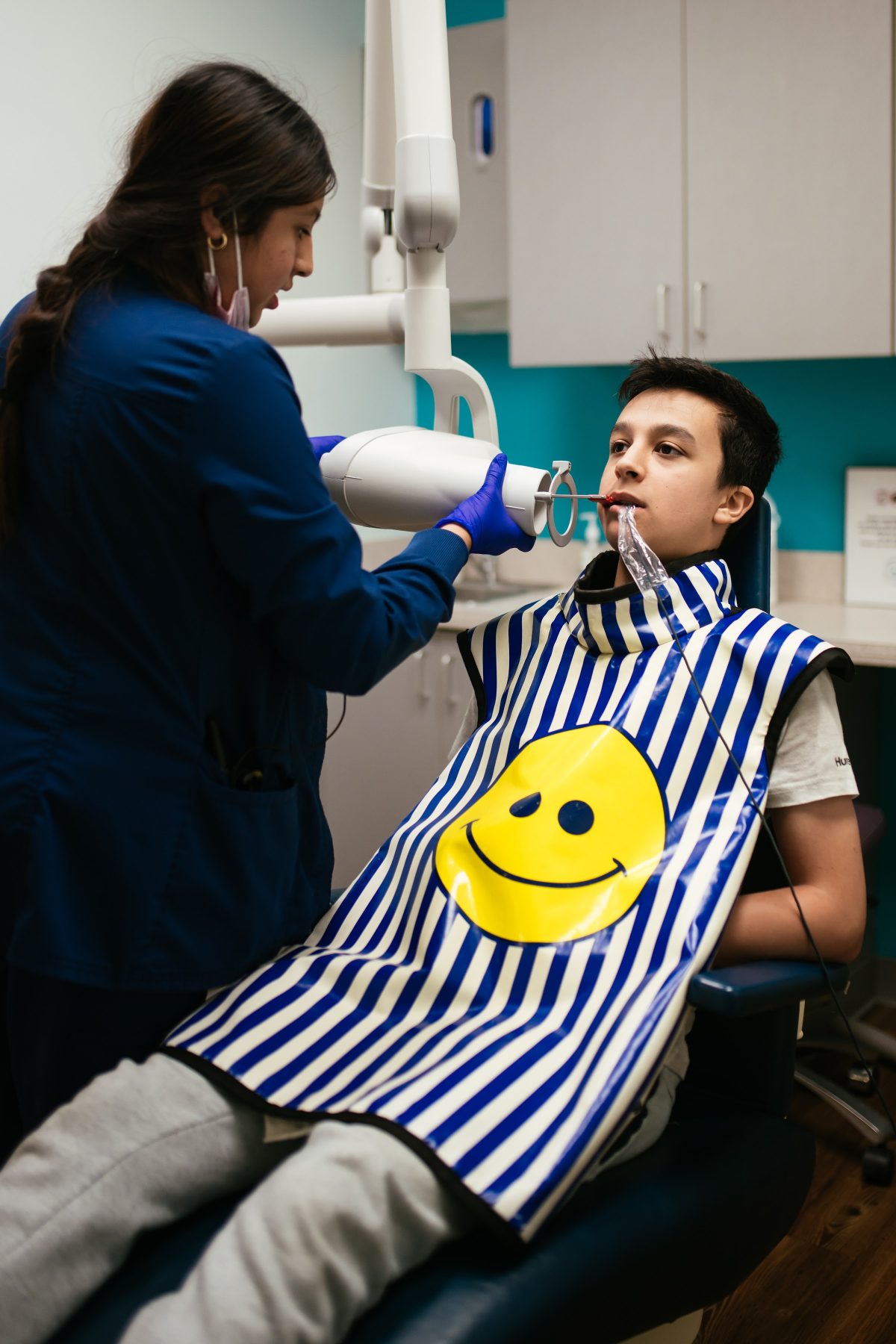
- X-rays happen only when there is a clinical reason to take them, not automatically.
Then we tell you what we saw. In plain words, with the reasoning, not a number code read off a chart.
For most children none of this hurts. There is a scratchy feeling during scaling, a cold spray of water, and a buzz from the polisher.
Gums that are already inflamed can be tender, because inflamed tissue bleeds and feels sore more easily. Tell us before we start if your child is sensitive and we will change how we work.
Why we check your child's bite at every cleaning
Our pediatric dentists look at bite and jaw development at every cleaning, from the very first one.
It adds nothing to the appointment and nothing to the bill. What it buys you is time: if something starts heading the wrong direction at seven, you hear about it then, not at thirteen when the options have narrowed.
toddler, preschooler, kid, teen
What the visit looks like, by age
The word "cleaning" covers wildly different appointments depending on how old your child is. It is the question we field more than any other, and the one nobody answers online.
About 1 to 3
Babies and toddlers, roughly ages 1 to 3
For a child this small, we often use a knee to knee position. You sit facing the dentist with your knees touching. Your child sits on your lap facing you, then lies back with their head in the dentist's lap.
Your child can see you and hold your hands the entire time. You are not handing them to a stranger.
The cleaning itself is usually a soft toothbrush polish rather than instruments. It takes a couple of minutes. Crying at this age is normal and it is not a sign the visit went badly.
The American Academy of Pediatric Dentistry recommends the first exam when the first tooth comes in, and no later than twelve months old.

About 3 to 5
Preschool, roughly ages 3 to 5
Kids this age can usually sit in the chair alone, which tends to surprise a parent who spent the week dreading it.
We show them each instrument before it goes near their mouth. The suction gets demonstrated on a finger first. The polisher gets turned on so they can hear it.
This is the age where the visit is as much about building the habit as it is about the teeth.
About 6 to 12
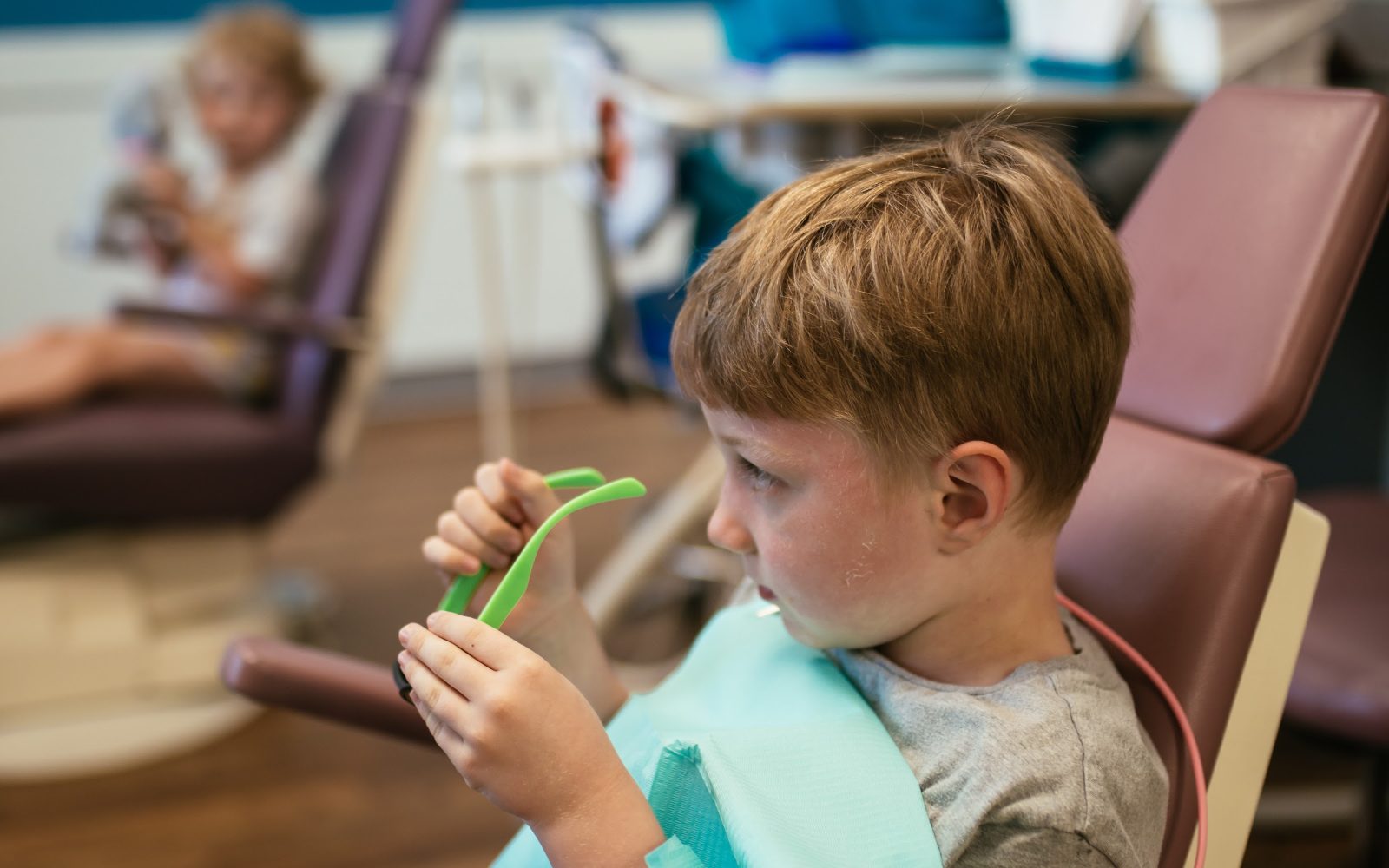
School age, roughly ages 6 to 12
Permanent molars arrive around six and twelve, and they arrive with deep grooves that a toothbrush bristle is physically too wide to clean.
This is when hand scaling usually starts mattering, because this is when real tartar starts showing up.
It is also the window when sealants are worth discussing. The CDC reports that sealants prevent up to 80% of cavities in back teeth for two years, and continue protecting against half of them for up to four.
13 and up
Teens
Teenagers get their own set of problems. Braces make plaque control harder. Hormonal changes during puberty can make gums react more strongly to the same amount of plaque than they did a year earlier.
Sports drinks and energy drinks show up in the enamel. So does vaping.
We talk to teenagers directly rather than over their heads to you. That tends to work better than anything we could tell you to tell them.
If you already know you want this booked, you can stop reading here.
Pick whichever of the four Richmond-area offices is easiest to get to and we will take it from there.
not sure what to expect?
Answer 3 Quick Questions
Three taps and we will point you to the part of this page that fits your child.
Question 1 of 3
How old is your child?
When was their last cleaning?
What is on your mind most?
Your starting point
it is a real finding
Yes, children get tartar on their teeth
A lot of parents are surprised by this, and a few are quietly suspicious that scaling a child's teeth is a way to pad the bill.
It is a real finding with real consequences. The American Academy of Pediatric Dentistry states that attachment loss from chronic subgingival calculus has been reported in young children, and that persistent gum inflammation in a child with decent brushing habits is often caused by calculus that was missed or only partly removed.
This is what it means for home care. Brushing and flossing remove plaque. They do not remove tartar. Once plaque hardens, only hand instruments, an ultrasonic scaler, or air polishing will take it off.
Which is why a cleaning is not something you can do at home, however good your kid's brushing is.
When we do not scale
Not every child needs hand scaling at every visit. A three year old with no calculus and no stain gets a toothbrush polish. That is the right treatment for that mouth on that day.
If you have been told by another office that your child's gums are too sensitive to scale, ask what they are seeing. Sometimes that is accurate. Sometimes it means the tartar is being left in place, which is a different conversation.
two people, one visit
Who your child will meet
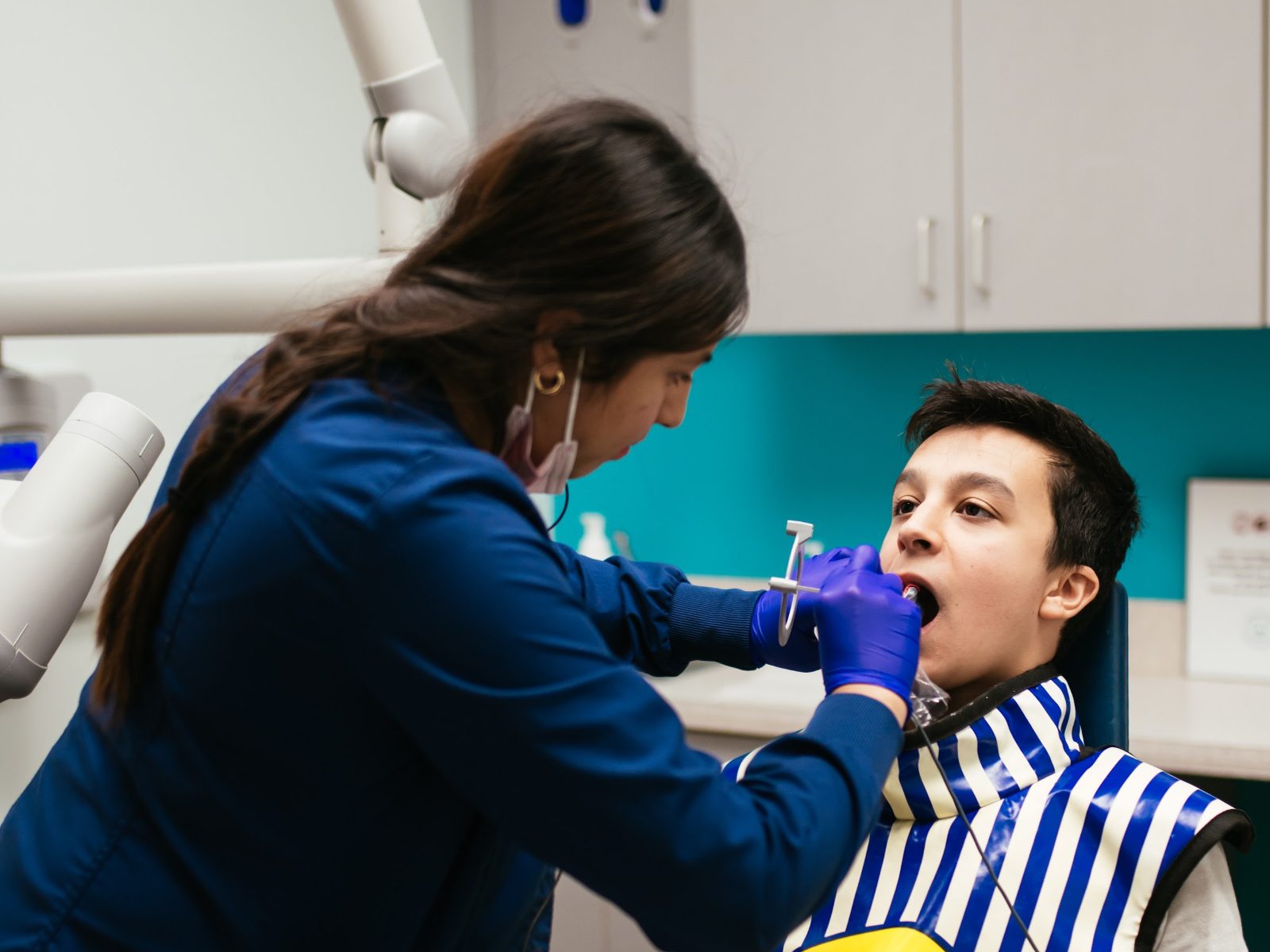
The hygienist and the dentist are two different people, and both of them will see your child in the same visit. Plenty of parents get to the car before they work that out.
The hygienist does the cleaning. She is the one with your child longest, usually fifteen to twenty minutes.
The pediatric dentist does the examination. A pediatric dentist completed two to three additional years of specialty training after dental school, focused specifically on children, including children with medical complexity and children who are frightened.
You will meet both. If you only remember one name, it will probably be the hygienist's, because she is the one who got your kid to open.
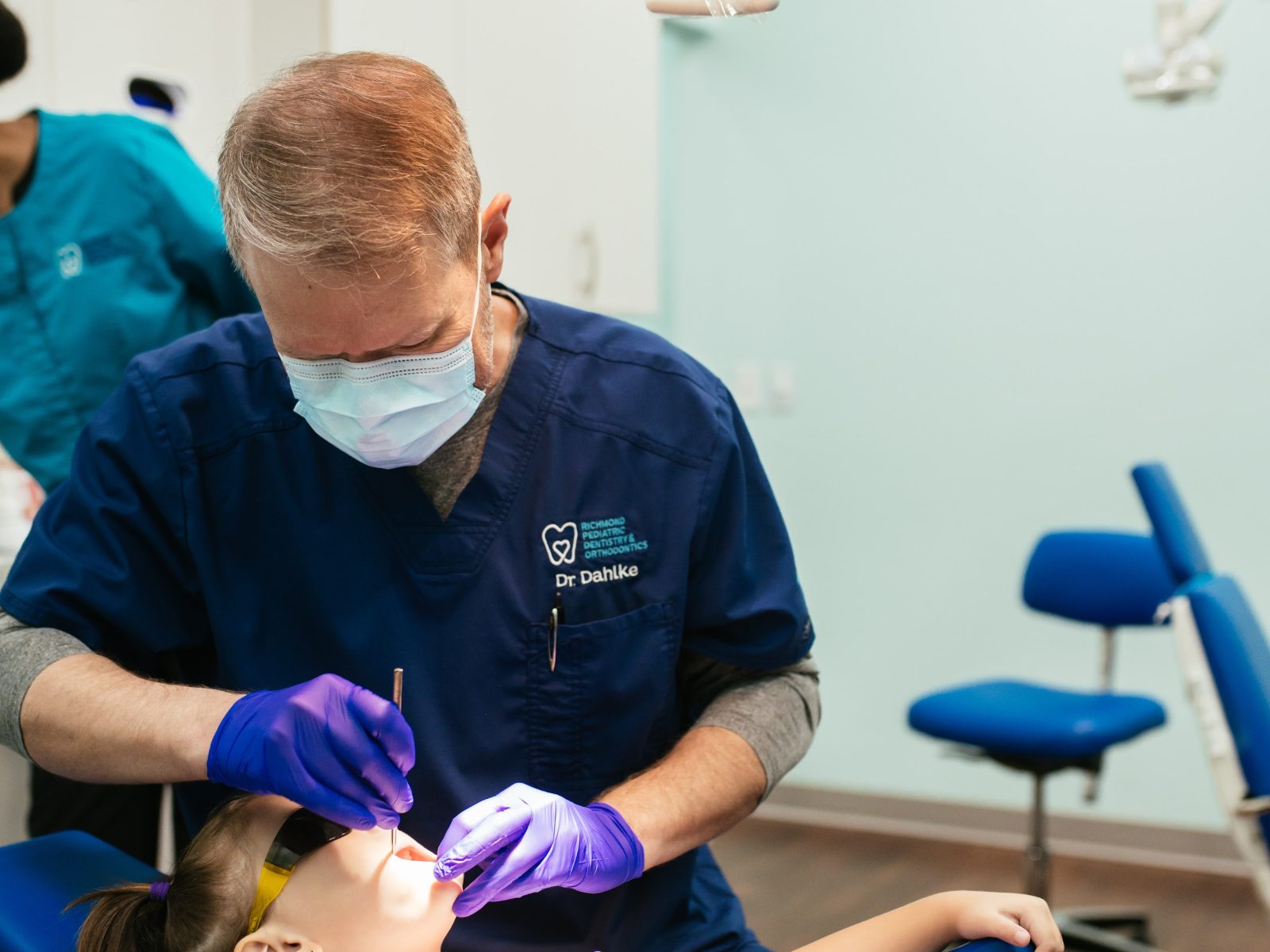
Being in the room
Some parents want to be right next to the chair. Others know their child does better without them in sight, and feel guilty about knowing it.
Both are normal and neither one is the wrong answer.
Tell us which you want when you book, and tell us again at the appointment if you change your mind. We would rather you ask than sit in a waiting room wondering.
your call, every time
Fluoride, and what happens if you say no
Fluoride varnish is offered at the end of the cleaning. It is painted on, it takes about a minute, and it is the only professional fluoride the AAPD recommends for children under six.
The evidence behind it is solid. The US Preventive Services Task Force recommends fluoride varnish for the primary teeth of all infants and children starting when teeth come in.
Some parents do not want it. They have read things, they are not sure, or they would rather wait.
So our position, in one line.
We will ask you. You can say no. Your child still gets the cleaning.
If you want to talk through what the research shows, including what is uncertain, we will have that conversation without making you feel handled. If you would rather just decline and move on, that is fine too, and nobody will bring it up three more times.
Declining fluoride will not get you marked as a difficult parent, and it changes nothing about how your child is treated here.
only when it earns its place
X-rays only when there is a reason
X-rays are not automatic at a cleaning.
If your child's teeth have spaces between them and we can see every surface, there may be nothing an X-ray would tell us that looking cannot. If the back teeth are touching, decay can hide between them where no exam will catch it, and that is when images earn their place.
When we do take one
We use child sized sensors. We will tell you why we want a particular image before we take it.
Saying no is fine
If you would rather not, say so. We will tell you honestly what we can and cannot rule out without it, and then it is your call.
the fear nobody says out loud
What if my child will not open their mouth?
This is the fear parents carry in and never say out loud.
Some kids cry. Some clamp shut. Some gag, and a few are sick.
None of it ends the appointment, and none of it is new to us. We have a whole practice full of pediatric specialists who chose this on purpose.
So we slow down. We get what we can, show your child whichever part is worrying them, and finish what is possible that day. A partial first visit that ends calmly is worth more than a complete one that ends in panic, because the next visit is the one that really counts.
If today is a hard day, we are not going to charge you for a fight.
If your child has been through something rough at a dental office before, tell us that when you book. There is more we can do for an anxious child than most families realize, and almost none of it involves sedation.
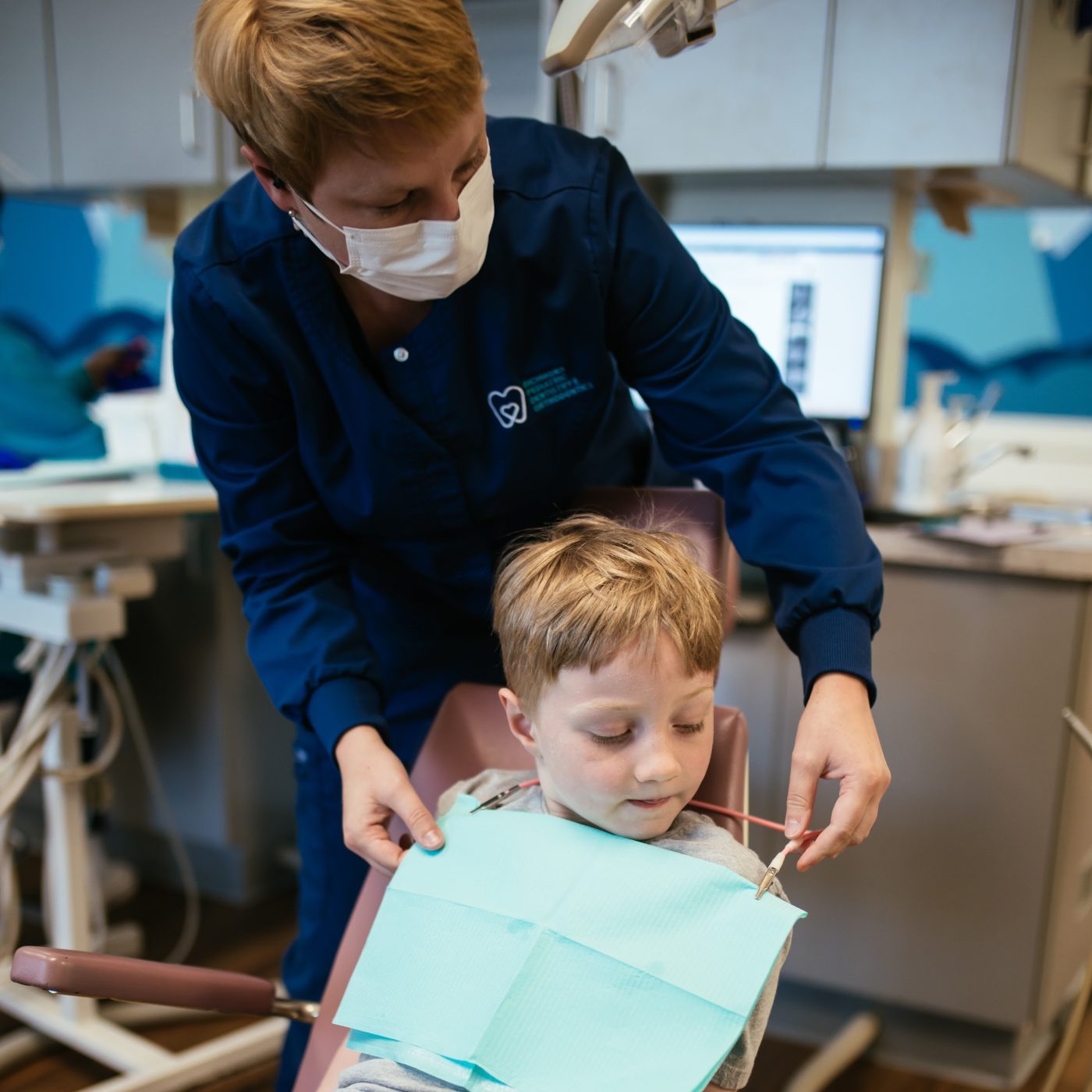
What to say on the drive over
If you are nervous about the dentist yourself, your child will read it on you before you say a word. A few things that help.
- Keep it short and boring. "We are going to get your teeth counted and cleaned."
- Skip the words that put an idea in their head. Hurt, shot, pull, drill. You do not have to promise it will not hurt, because that plants the possibility.
- Do not make it a reward or a threat. Both raise the stakes.
- If they ask a question you cannot answer, it is fine to say you do not know and we will find out together.
same words at home
What we call things, and what you can call them at home
Kids handle the visit better when the words are not frightening. Here is the vocabulary our team uses, if you want to use the same words at home beforehand.
| What it is | What we call it with your child |
|---|---|
| Clinical examination | Counting your teeth |
| Scaler, hand instrument | The tooth tickler |
| Polisher and prophy paste | The spinny toothbrush with gritty toothpaste |
| Saliva suction | Mr. Thirsty, the straw |
| Fluoride varnish | Tooth vitamins |
| Dental X-ray | A picture of your tooth |
| Cavity, decay | A sugar bug |
twice a year, for most kids
How often should kids get their teeth cleaned?
Every six months is the baseline, and it is not a marketing number. It comes from the AAPD's periodicity schedule.
It is also not a rule for every child. The AAPD is explicit that intervals are based on individual risk, and that children at higher risk of decay or gum disease do better on a shorter cycle, sometimes every three months.
We will tell you which one your child is and why. If six months is right, we are not going to invent a reason to see you sooner.
6 months
The baseline for most kids
3 months
Sometimes, for kids at higher risk
Higher risk usually means
- A history of cavities
- Orthodontic appliances that trap plaque
- Certain medications
- A medical condition affecting saliva
- A stretch where home brushing fell apart
no surprises at the front desk
How much does teeth cleaning for kids cost in Richmond?
If your child is on Virginia Medicaid or FAMIS, this section is short and it is good news.
Virginia's children's dental program, Cardinal Care Smiles, covers a checkup, a cleaning, and fluoride every six months for members under 21. X-rays are covered when they are needed. Sealants are covered on permanent molars.
There are no copays for dental care in the Cardinal Care Smiles program.
RPDO participates with all Virginia Medicaid, Doral, and DentaQuest. That is not true of every pediatric office in Richmond, and it is worth checking before you book anywhere.
If you have private dental insurance, two cleanings a year are covered at or near 100% on most plans, because preventive care is the one thing insurers want you to use.
If you are paying out of pocket, what you pay depends on what the visit includes. A cleaning and exam alone is one number. Add X-rays, fluoride, or sealants and it changes.
Call us with your child's age and how long it has been, and we will quote you the visit before you come in rather than after.
One clarification worth making, because it costs families real money in worry. A "deep cleaning" is a specific periodontal treatment, usually for adults with gum disease. It is not what your child is getting, and it is not what you are being charged for.
the outcome you are bracing for
If we find a cavity
This is the outcome you are bracing for, so let us walk through it.
We tell you what we found, where it is, and how deep. We show you on the image if there is one.
Then we tell you the options, including the ones that are not drilling.
What we care about is what we do next, and doing it before it turns into a toothache at 2 a.m.
The options we talk through
Depending on the tooth and your child's age, that can mean:
- Watching a spot that has not broken through yet
- Silver diamine fluoride to arrest it
- A filling
Worth saying plainly
Finding a cavity is not a verdict on your parenting.
Decay is the most common chronic disease of childhood, more common than asthma. It happens in households that brush twice a day.
around six and twelve
Sealants, and when they come up
If your child is around six or twelve, we will probably mention sealants at the cleaning.
Permanent molars come in with grooves deep enough that a toothbrush bristle physically cannot reach the bottom. A sealant is a thin coating that fills those grooves so food and bacteria cannot settle in.
We will bring it up when the molar is actually in and dry enough to bond. Not before, and not on teeth that do not need it.
Up to 80%
of cavities in back teeth prevented over two years, the CDC reports
What it involves
- A few minutes per tooth
- No numbing and no drilling
- Virginia Medicaid covers sealants on permanent molars
- Most private plans cover them too
the routine at home
Between cleanings
Two minutes, twice a day
Two minutes, twice a day, is the target, and the second one is the one that counts because saliva flow drops overnight.
Help with brushing, for longer than you think
Children need help brushing for longer than you would think. Around the time they can tie their own shoes is a reasonable marker for letting them take over, with you checking after.
Floss where teeth touch
Floss where teeth touch. If they do not touch, floss is optional there.
How often matters more than how much
Watch the frequency of sugar more than the quantity. A juice box finished in ten minutes does less damage than the same juice box sipped across an afternoon, because it is the number of acid attacks that wears enamel down.
There is more in our at home oral hygiene guide, including what to do about the kid who fights you every night.
And if the routine falls apart for a few months, it falls apart. Start again. That is all we expect.
one practice, one chart
When braces come up, you are already here
Most children who need orthodontics find out from their pediatric dentist. In a lot of practices that is where the trail goes cold. You get a name on a sticky note, you call a stranger's office, you fill out the history again, and somebody takes a fresh set of X-rays of a mouth that has already been photographed twice this year.
That is not how it works here.
Our orthodontists and our pediatric dentists are one practice working from one chart. The records are already there. So is the growth history, the eruption pattern, and the note from three years ago about the baby tooth that came out early. The handoff is a scheduling change, not a referral.
The orthodontic consult is free and you do not need anybody's permission to book it.
The age seven check, and why it usually ends in "not yet"
The American Association of Orthodontists suggests a first orthodontic look around age seven. Because your child's bite is already being watched at every cleaning, that look tends to happen on our schedule instead of yours.
Most of the time it ends with "not yet, let's watch it." That is the answer you want, and it is worth something to hear it from someone who has been tracking the same mouth since it had eight teeth in it.
When the answer is eventually "now," you are not starting over with anyone.

boring is the goal
What this looks like in a few years
The version of this that works is boring, and boring is the goal.
Your child walks in without having to be talked into it. They know the hygienist by name. Cleanings come around twice a year and not much happens at them, because not much has been allowed to build up.
When something does turn up, it turns up small. A watch spot instead of a filling. A filling instead of a crown and a morning under anesthesia.
And at some point you stop bracing before these appointments, because there stops being anything to brace for.
That is what we are trying to build, and it takes years. It starts with one cleaning.
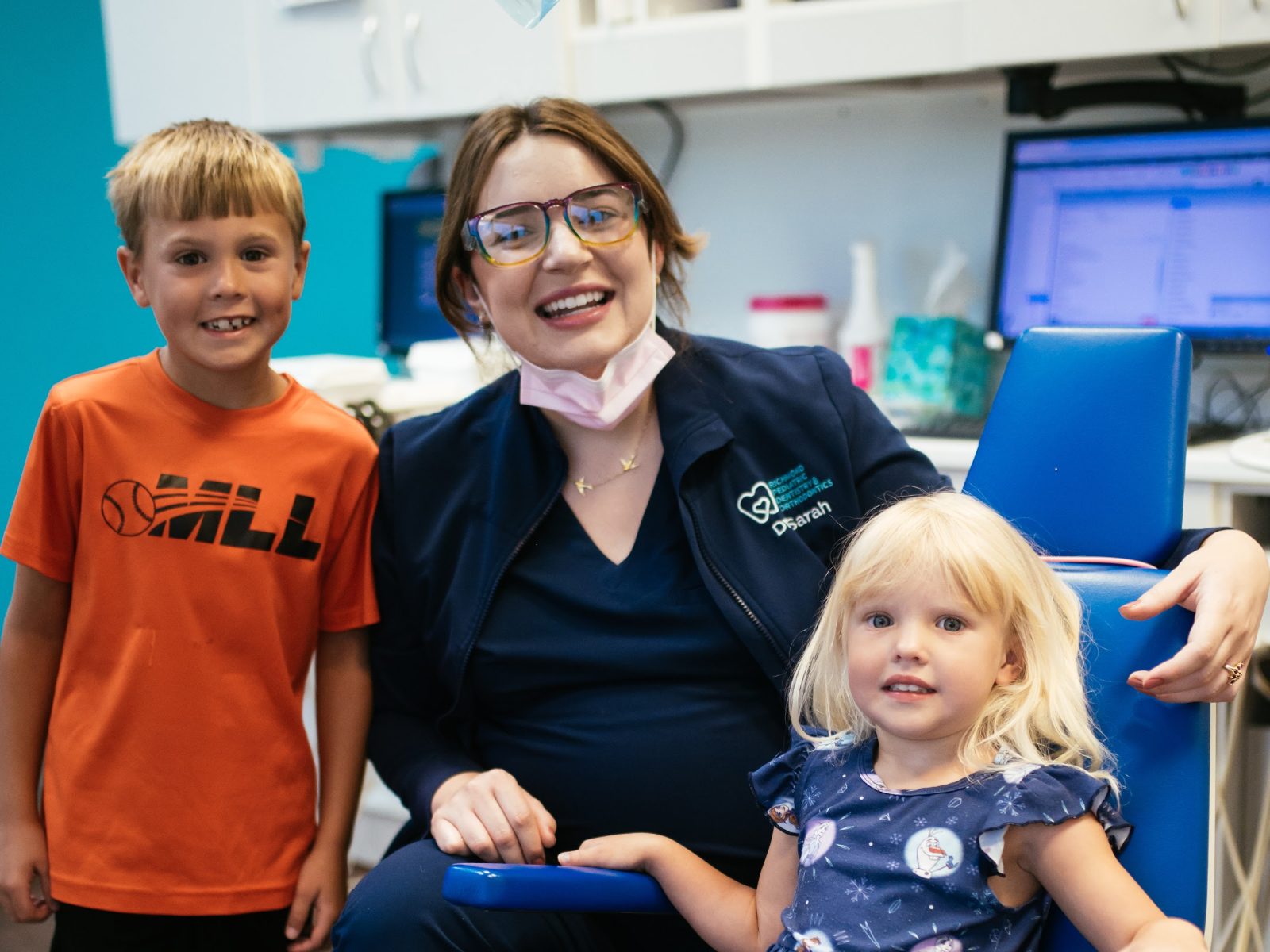
pick the one on your way
Where we see Richmond families
We have four pediatric offices around the Richmond area, and two of them have Richmond addresses.

Short Pump
Closest for families in Short Pump, Innsbrook, Wyndham, and western Henrico County.
12270 West Broad Street
Richmond, VA 23233
Mon to Thu 8 a.m. to 5 p.m.
Fri 8 a.m. to 1 p.m.

West End
Serving Tuckahoe, Gayton, Ridgefield, and the rest of the West End.
2560 Gaskins Road
Richmond, VA 23238
Mon to Thu 8 a.m. to 5 p.m.
Fri 8 a.m. to 1 p.m.

Mechanicsville
The one Hanover County families use, along with Atlee, Rural Point, and Old Church.
7521 Right Flank Road, Suite 110
Mechanicsville, VA 23116
Mon to Thu 8 a.m. to 5 p.m.
Fri 8 a.m. to 1 p.m.

Midlothian
For Chesterfield County, Brandermill, Woodlake, and Bon Air. If you are south of the river, we have a page specifically on teeth cleaning for kids in Midlothian.
13901 Coalfield Commons Place, Suite 101
Midlothian, VA 23114
Pediatric visits on Wednesdays
8 a.m. to 5 p.m.
We are privately owned, we are not part of a chain, and the practice has been taking care of Richmond children for over 100 years. If you are still deciding between practices, we wrote an honest comparison of how to pick a dentist for your kids in Richmond.
questions parents ask
Frequently asked questions
At what age should my child get their first teeth cleaning?
The AAPD recommends a first dental exam when the first tooth comes in, and no later than twelve months. At that age the cleaning is usually a soft brush polish and the bigger purpose is establishing a dental home and going over feeding, bottles, and brushing with you.
How long does teeth cleaning for kids take?
Plan on about 45 minutes for a full visit including the exam and time to talk with you. The cleaning itself is a smaller piece of that, usually fifteen to twenty minutes, and less for toddlers.
Is teeth cleaning for kids different from an adult cleaning?
The steps are similar but the execution is not. Instruments are smaller, the polish is gentler, the technique changes with age, and a toddler may get a toothbrush polish instead of scaling. The exam is also different, because we are tracking growth, eruption, and bite development that an adult exam has no reason to check.
Does teeth cleaning hurt?
For the large majority of children, no. There can be a scratchy or buzzy feeling during scaling and a cold spray of water. Kids with inflamed gums may be tender in spots, since inflamed tissue bleeds and feels sore more easily. Tell us if your child is sensitive and we will adjust.
How often should my child have their teeth cleaned?
Every six months for most children. The AAPD sets that as the default and adds that higher-risk children benefit from more frequent visits, sometimes every three months.
Can my child get a cleaning if they will not open their mouth?
Often yes, in stages. We get what we can, keep it calm, and build on it next time. A visit that ends without a fight is not a failed visit.
Do children really get tartar?
Yes. The AAPD notes that calculus deposits cause persistent gum inflammation in young patients and that attachment loss from subgingival calculus has been reported in children. Brushing removes plaque but cannot remove tartar once it hardens.
Do you have to do fluoride?
No. We offer it, we will explain what it does, and you can decline. Your child still gets the cleaning either way.
Are dental X-rays safe for children?
The radiation from dental images is very low and we use child sized sensors. We also do not take them by default. We take them when there is something an examination cannot see, most often decay between touching back teeth, and we will tell you the reason first.
Does Medicaid cover teeth cleaning for kids in Richmond?
Yes. Virginia's Cardinal Care Smiles program covers a cleaning, checkup, and fluoride every six months for members under 21, with no copays. RPDO participates with all Virginia Medicaid, Doral, and DentaQuest.
What is the difference between a cleaning and a deep cleaning?
A routine cleaning removes plaque, stain, and tartar above and just below the gumline. A deep cleaning, or scaling and root planing, is a periodontal treatment for established gum disease and is uncommon in children. If someone quotes you a deep cleaning price for a child, ask what they are finding.
How much is a children's teeth cleaning?
Covered twice a year with no copay on Virginia Medicaid, and at or near 100% on most private plans. Paying cash, it depends on what the visit includes, so call and we will price it before you book.
Can my child eat before a dental cleaning?
Yes. Eat normally. A cleaning is not a procedure that requires an empty stomach, and a hungry child has a much harder appointment than a fed one. Fasting only applies if your child is scheduled for sedation, and we would tell you that well ahead of time.
Should my child brush before the appointment?
If it fits in the morning, sure. If it does not, come anyway. We are about to clean their teeth. No one here is grading your work on the way in.
My child has not been to a dentist in years. Will you say something?
No. Bring them in. We will tell you what your child's mouth needs now and what order to do it in. What happened before that is not a conversation we need to have.
we'll take it from here
Bring them in
You do not need a referral, and you do not need to have any of it figured out first.
Request a visit online or call. Pick whichever of the four offices is easiest to get to. First visits run about 45 minutes, so leave a little room in the morning.
Bring your insurance card. Bring anything you think we should know before your child sits down, including the bad experience at the last place, the sensory stuff, the tooth you are worried about, or the fact that it has been three years. Tell the person at the desk. It changes how we run the appointment, and it is never held against you.
Then let us take it from there. That is the part you have been dreading, and it is the part that is our job.
