Clinically reviewed by Dr. Kevin Bibona, DDS, Specialist in Orthodontist at Richmond Pediatric Dentistry and Orthodontics
Your child’s dentist said “open bite” at the last checkup. You nodded, smiled, drove home, and immediately Googled it. Now you’re reading about jaw surgery and wondering how a routine cleaning turned into this. Take a breath — it almost certainly isn’t what you’re imagining. Open bite treatment in Richmond, VA is one of the more common things we handle at RPDO, and for most kids, teens, and adults, the answer is braces or clear aligners — not an operating room. What matters most is getting the right evaluation, from the right team, at the right time.
At Richmond Pediatric Dentistry and Orthodontics, our orthodontists treat open bites at four locations across Short Pump, Mechanicsville, Midlothian, and Richmond. And because our pediatric dentists and orthodontists work under the same roof, your child may already have a head start — one conversation away from a real plan.
And because our pediatric dentists and orthodontists work under the same roof, your child may already be in exactly the right place — one conversation away from a real plan.
On This Page
What You’ll Find Here
- What an open bite actually is — and why “it might fix itself” is sometimes true but often isn’t
- The most common reason open bites come back after treatment (most parents have never heard of this)
- What your treatment options actually look like — and when surgery is genuinely necessary vs. genuinely overstated
- Why catching an open bite early matters so much for families across Henrico, Chesterfield, and Hanover County
- What Richmond families are saying about care at RPDO
- Every question you’ve been quietly Googling — answered honestly
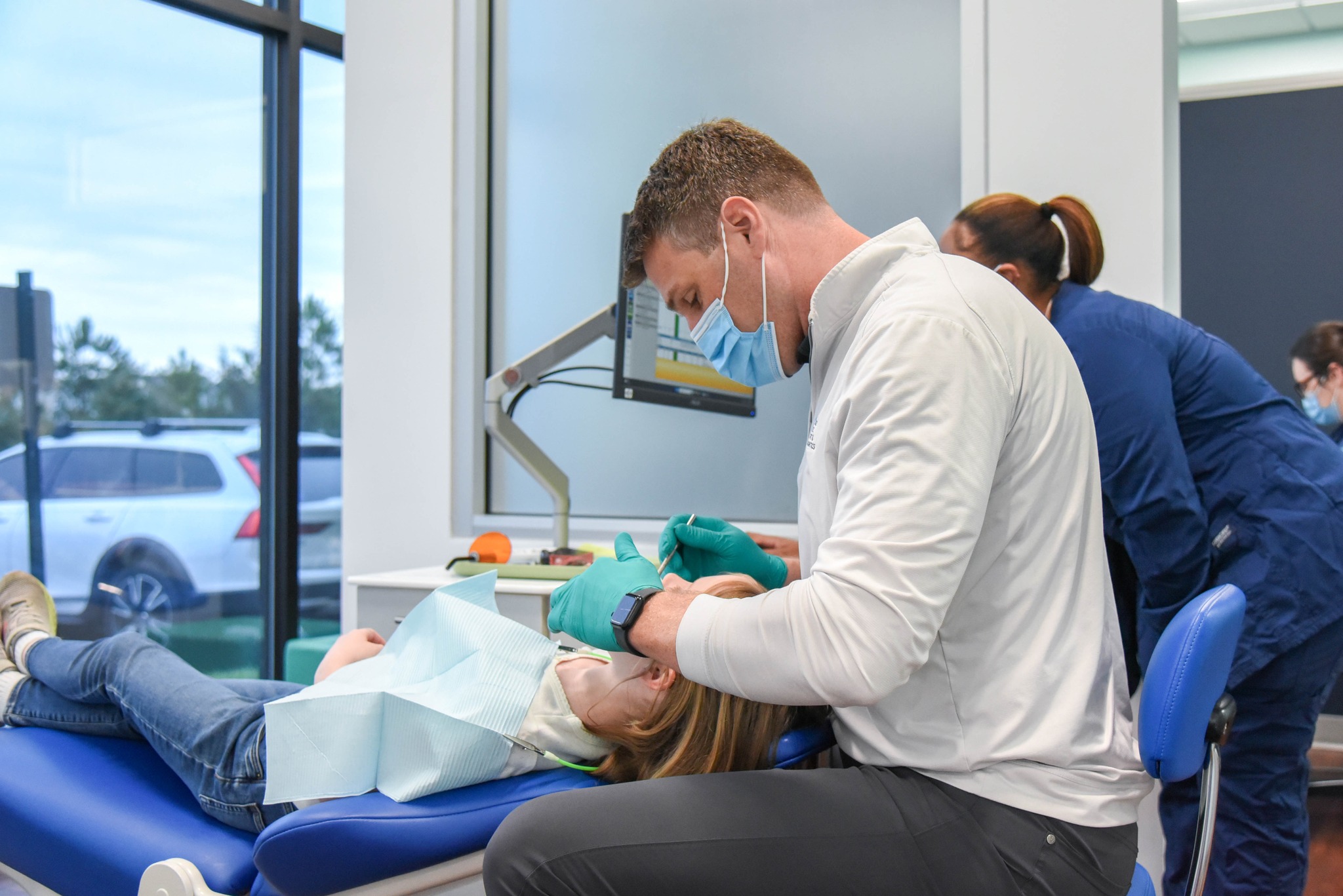
What Is an Open Bite?
An open bite is a type of bite misalignment where the upper and lower teeth don’t make contact when the jaw is fully closed. The most common form is an anterior open bite — where the back teeth meet but the front teeth leave a visible gap.
Less common is a posterior open bite, where the front teeth touch but the back molars don’t connect properly.
That gap might seem minor from the outside, but parents often notice it affects real daily life: their child can’t bite cleanly into an apple, certain speech sounds come out a little differently, and there’s a visible openness to the smile that kids — especially as they get older — sometimes become self-conscious about.
The good news is that open bites are treatable. The right approach depends on the cause, the type, and how old your child is. Not sure where to start? Our what to expect at your consultation page walks through exactly what happens at an RPDO orthodontic evaluation.
Why Your Child’s Open Bite Might Have Been Caught at a Dental Cleaning
This is something unique to families at RPDO, and it matters more than most people realize.
Because our practice offers pediatric dentistry and orthodontics together under one roof, your child’s dentist and orthodontist are on the same team.
When a dental hygienist or pediatric dentist notices that a child’s front teeth aren’t closing — at a routine cleaning, before you’ve even thought about orthodontic treatment — they can flag it early and connect you with an orthodontist in the same visit.
That coordination is the difference between catching a habit-related open bite at age seven, when jaw-guided correction is genuinely possible, and showing up at a general orthodontist at fourteen wondering why the window for easier treatment has already closed.
If RPDO’s pediatric team has already mentioned an open bite to you, you’re already in the right place. The next step is simply a conversation with one of our orthodontists.
What Causes an Open Bite?
The most important thing parents want to know first: did I cause this? In most cases, the honest answer is no. The causes are usually developmental, habitual, or structural — and most of them are things nobody could have prevented just by paying closer attention.
How Do I Stop My Child’s Thumb Sucking from Causing Permanent Tooth Problems?
The short answer: address it before the permanent teeth fully come in, and bring it up at your orthodontic evaluation. Most children naturally stop thumb sucking on their own by age three or four. When the habit continues past that point — especially once adult teeth start erupting — it begins to apply real, consistent pressure that shifts tooth position over time.
The good news is that habit-related open bites caught early are the most straightforward kind to correct, and our orthodontists can build habit support strategies directly into the treatment plan.
Thumb sucking and prolonged pacifier use are the most well-known causes. The gentle, consistent outward pressure on developing front teeth can shift their position over time. These are called dental open bites, and they tend to be the most straightforward to correct, especially in kids whose jaws are still growing.
Tongue thrusting is less talked about but extremely common — and it’s the hidden reason many open bites come back after treatment (more on this below). It’s a swallowing pattern where the tongue pushes forward against or between the front teeth instead of resting on the roof of the mouth. Most people who do it have no idea they’re doing it.
Skeletal growth patterns play a larger role in teens and adults. Sometimes the upper and lower jaws simply grow in a way that leaves a vertical gap that tooth movement alone can’t fully close. These cases are more complex — but surgery is still not the automatic answer many families fear.
The One Thing That Causes Open Bites to Relapse — and Why We Address It from the Start
If there’s one thing most orthodontic content doesn’t cover well enough, it’s this: an open bite that gets closed can open back up again if the underlying cause isn’t addressed during treatment.
The most common culprit is unresolved tongue thrusting. When someone thrusts their tongue forward during swallowing — something that happens hundreds of times every single day — that repeated pressure against the front teeth works against the correction.
The bite closes during treatment. The habit continues after. Over months or years, the teeth gradually drift back.
At RPDO, evaluating tongue posture and swallowing patterns is part of every open bite assessment. Depending on what our orthodontists find, the plan may include habit awareness, a referral to a myofunctional therapist (a specialist who works on oral muscle function and swallowing patterns), or for younger patients, an appliance that gently discourages the tongue from thrusting forward during active treatment.
Getting the bite closed is half the job. Keeping it closed is the other half.
What Happens If an Open Bite Isn’t Treated?
Parents sometimes wonder whether it’s worth treating at all — especially if their child seems to have adapted. It’s a fair question, and deserves a straight answer.
Uneven tooth wear. When the front teeth don’t participate in biting, the back teeth absorb more force than they were designed to handle. Over years, that shows up as wear, cracking, and sensitivity.
Chewing changes. Kids and adults with open bites often adapt their eating habits without even realizing it — tilting their head, avoiding certain textures, using their tongue to manage food differently. The compensation accumulates quietly.
Speech patterns. Sounds like “s,” “z,” and “th” depend on a specific relationship between the tongue and the front teeth. A gap changes that, and some people develop subtle speech differences around it.
The gap can widen. If tongue thrusting or other habits are still active, the teeth keep being pushed outward. A mild open bite at age eight can become a noticeably larger problem by the teen years.
Confidence matters too. This doesn’t get said enough — kids notice their own smiles. Teens especially. An open bite that affects how a smile looks in photos or how certain words sound can quietly chip away at confidence during years when it matters a great deal.
Treatment earlier is nearly always easier and less involved than treatment later. But adults who’ve been managing an open bite for years can still achieve excellent results with the right approach.
Treatment Options at RPDO
There’s no single right answer for every open bite. Our orthodontists evaluate each case individually — the cause, the type, the patient’s age, and what’s actually going on with their jaw — before recommending anything.
| Treatment | What It Does | Best For |
|---|---|---|
| Braces | Precise multi-directional tooth movement, often paired with elastics for vertical force to help close the bite | Complex cases, moderate-to-significant bite correction needed — any age |
| Clear Aligners | Removable aligners that move teeth gradually; creates a natural bite block effect on back molars | Mild to moderate dental open bites; teens and adults wanting a discreet approach |
| Early Intervention | Habit appliances, expanders, or close monitoring to guide jaw growth before problems become complex | Children with habit-related open bites while the jaw is still developing (ages 6–10) |
| Surgical Orthodontics | Jaw repositioning for severe skeletal cases where tooth movement alone can’t produce a stable result | Adult skeletal cases only — when non-surgical options have been evaluated and won’t achieve a lasting result |
Braces
For more involved open bites — especially those with any skeletal component or that require significant tooth movement in multiple directions — braces give our orthodontists precise control over every individual tooth. They’re frequently used with elastics, which add vertical force to help bring the upper and lower teeth toward each other.
Ceramic braces are available for patients who want a less visible option while still getting the mechanical advantages of fixed treatment. See our full braces overview at RPDO and our braces in Richmond guide to understand what to expect. Want to see real results? Browse our smile gallery.
Clear Aligners
A lot of families assume clear aligners can’t handle an open bite. That assumption is understandable — but for many dental open bites and moderate cases, it’s not accurate.
When worn consistently (20–22 hours a day), clear aligners create a natural bite block effect through the aligner material across the back teeth. This helps the jaw rotate into better alignment as the front teeth come together.
For teens who want the most discreet path through treatment, and for adults managing an open bite in a professional environment, clear aligners are a genuinely effective option for the right cases.
Not every open bite is a good candidate for aligners alone, and our orthodontists will tell you clearly which path makes sense for your bite. Learn more on our clear aligners page.
Early Intervention for Kids
The American Association of Orthodontists recommends a first orthodontic evaluation by age seven. For open bites specifically, that recommendation carries real weight.
Habit-related open bites are most effectively corrected while the jaw is still developing. At age seven or eight, the bone has time to remodel naturally as adult teeth continue to come in. Wait until growth is complete and that window is gone — treatment becomes more involved, and some options that were straightforward earlier require more extensive approaches later.
RPDO’s early orthodontic treatment program is designed for exactly this stage. Children who aren’t ready for active treatment yet can be monitored at regular intervals — no pressure, no commitment, just careful attention at the right moment.
When early intervention does make sense, it typically involves a shorter active phase focused on guiding jaw and tooth development before all the permanent teeth have arrived — often called Phase 1 treatment. Our guide to the stages of orthodontic treatment for children walks through what this typically looks like from evaluation through completion.
If your child’s dentist — whether at RPDO or elsewhere — has flagged an open bite, or you’ve noticed that the front teeth don’t touch when your child bites down, a free evaluation is the right next step.
When Surgery Is Actually Necessary
For severe skeletal open bites where the jaw structure itself is the root problem — and where orthodontic movement alone cannot produce a stable, lasting result — surgical orthodontics may be the right path. This is a real option, and when it’s genuinely what’s needed, our orthodontists will explain exactly why and walk you through the full process.
What we won’t do is recommend surgery when a less invasive approach will get the job done well. The treatment recommendation is always based on what will actually work for your specific bite — not on what’s easier to present, or what sounds most impressive.
What Richmond-Area Families Are Saying
Read more on our patient testimonials page or browse our smile gallery to see the results for yourself.
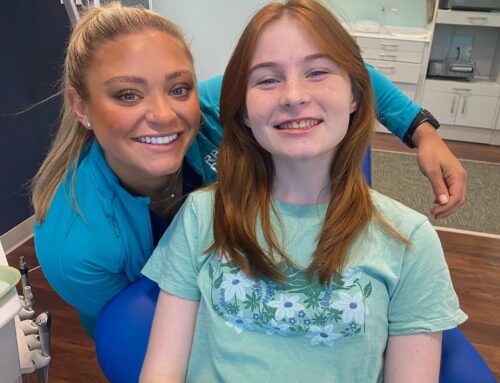
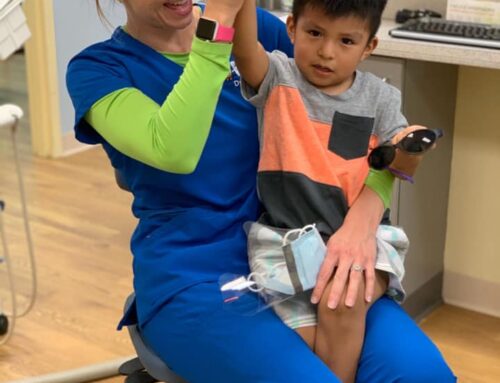
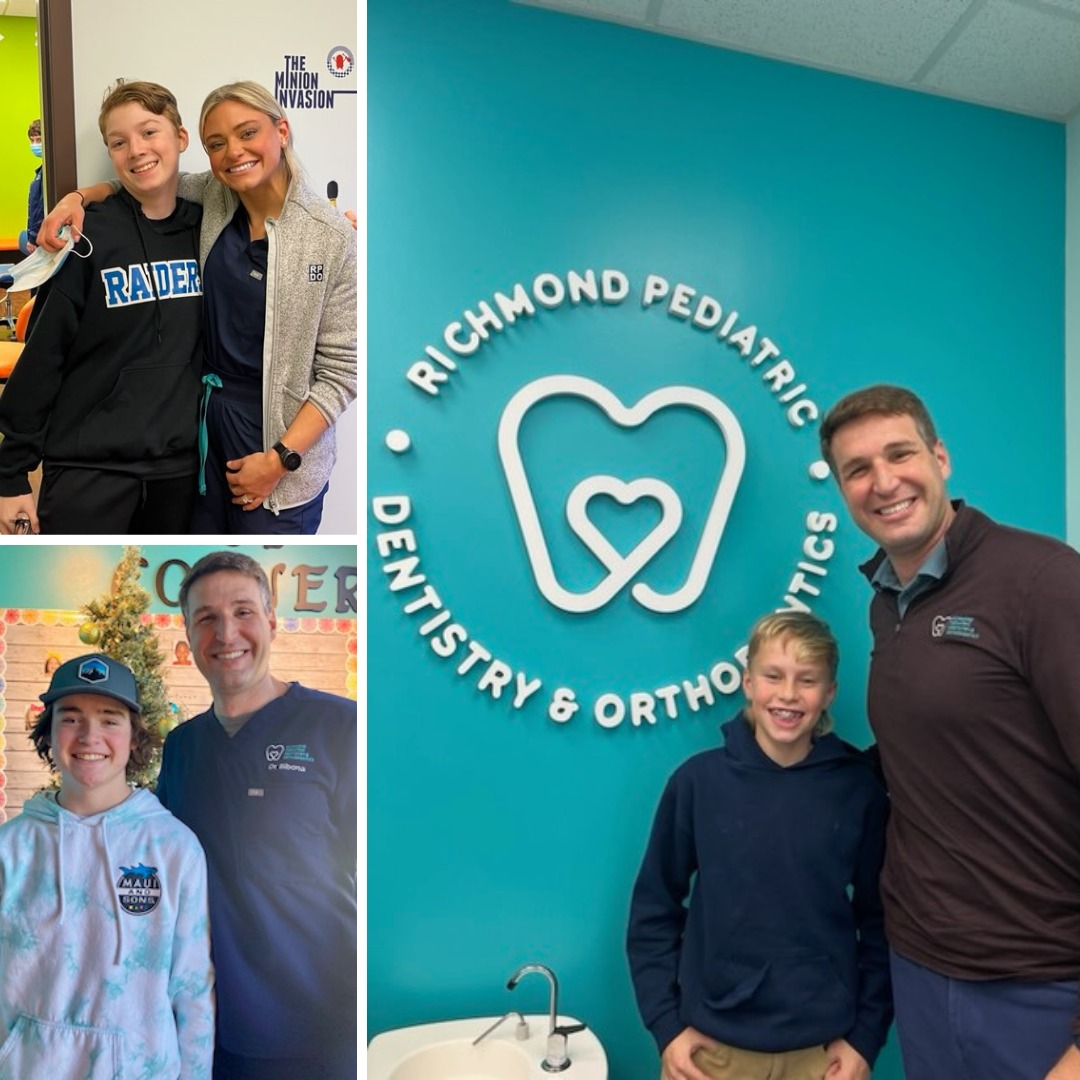
Dr. Cook and all of the staff at RPDO made this experience for our son wonderful!! Kaitlyn was so patient and positive with our son. I highly recommend RPDO both for dentistry and orthodontics! Look at this great smile.
My daughter was feeling nervous about getting her braces removed, but Kaitlyn immediately put her at ease with her warm, calming presence. By the end of the visit, my daughter’s nervousness had completely turned into joy when she saw her beautiful new smile — thanks to the expert care of Dr. Cook and the thoughtful support from Kaitlyn.
My 9-year-old had a consultation today and although he doesn’t need braces right now, if and when he does, we won’t go anywhere else but RPDO. Dr. Bibona was professional while putting my son at ease. It’s important to me that my kids don’t have bad experiences like I had — use this provider’s services, you won’t be disappointed!
Why Richmond Families Choose RPDO for Open Bite Treatment
Open bites are among the more technically demanding bite corrections in orthodontics. The difference between a result that holds and one that gradually reopens often comes down to the thoroughness of the initial evaluation and how carefully the underlying causes are addressed during treatment.
A team that already knows your child. This might be the most underappreciated part of choosing a bi-specialty practice. If your child has been a patient at RPDO for dental care, our orthodontists can review their dental history, coordinate with their pediatric dentist, and start their evaluation with context no stand-alone orthodontic office would have. You’re not starting from scratch — your child’s care is already connected.
Orthodontists who take the time to explain. Parents who come to RPDO for open bite evaluations consistently mention one thing: they left the consultation actually understanding what was going on. Not a list of options handed off by a coordinator. A real conversation with the person who would be managing their child’s care.
100+ years serving Richmond families. RPDO has been part of the Greater Richmond community since 1919. That longevity isn’t just a marketing point — it reflects the kind of trust that takes generations to build. Families across Henrico County, Chesterfield County, and Hanover County have brought their children here for over a century.
Five convenient locations. Short Pump near West Broad Street. Mechanicsville off I-295. Midlothian near Coalfield Commons. West End on Gaskins Road. And our Richmond office on Patterson Avenue for orthodontics close to the city. Whether you’re coming from Glen Allen, Bon Air, Tuckahoe, or anywhere in the Greater Richmond metro, there’s an RPDO office nearby.
Award-winning care. RPDO has been recognized by Richmond Magazine, the Richmond Times-Dispatch, Style Weekly, and Virginia Living — awards earned from the community we serve.
Flexible financing and insurance. We accept most major insurance plans and offer flexible payment options to make orthodontic care accessible for families across the Richmond metro. Visit our insurance information and flexible financing pages for details.
Not sure if you’re ready for an in-office visit? Start with a virtual smile assessment from the convenience of home. New to orthodontics altogether? Our essentials of orthodontics guide for parents is a great starting point.
What Does Open Bite Treatment Cost in Richmond, VA?
Open bite treatment with braces at RPDO typically ranges from $3,000 to $7,000 depending on the complexity of the case, the type of treatment used, and how long treatment is expected to take. Straightforward dental open bites may fall on the lower end. Cases with a more significant skeletal component, or those requiring a longer treatment timeline, will be toward the upper end.
Your free consultation includes a complete breakdown — insurance benefits applied, payment plan options explained, and total out-of-pocket cost with no surprises before you commit to anything.
What to Expect at Your Free Consultation
If you’ve been wondering whether the open bite you’ve noticed is worth bringing in, here’s exactly what happens.
You’ll meet with one of our orthodontists and the RPDO team — in a warm, kid-friendly environment where children actually want to come back.
We’ll take digital X-rays and images to give our orthodontist a complete view of your child’s teeth, jaw structure, and bite. This is what makes it possible to determine whether an open bite is dental, skeletal, or a combination — and to build a treatment plan that actually fits your child’s situation.
Our orthodontist will walk you through everything in plain language. Not clinical shorthand. You’ll leave with a clear picture of what’s going on, what treatment would look like, how long it would take, and what it would cost.
There’s no pressure and no obligation.
Frequently Asked Questions About Open Bite Treatment
Can an Open Bite Be Fixed Without Surgery?
In many cases, yes. Dental open bites caused by habits or tooth position — the most common type — often respond very well to braces or clear aligners. Surgical orthodontics is typically reserved for severe skeletal cases where the jaw structure itself is the root problem and orthodontic movement alone can’t produce a stable result.
Our orthodontists always evaluate non-surgical paths first and will be clear with you about which category your child’s bite falls into.
Can Clear Aligners Fix an Open Bite?
For mild to moderate dental open bites, they often can. When worn consistently, clear aligners create a bite block effect that helps the jaw rotate into better alignment.
More complex or skeletal cases may require braces or a combined approach. Your consultation will give you a specific answer based on your child’s actual bite — not a general estimate.
How Long Does Open Bite Treatment Take?
Most open bite cases take between 12 and 24 months. Simpler dental cases may land on the shorter end; cases with a more significant skeletal component generally take longer. You’ll get a personalized timeline at your consultation.
My Child Still Sucks Their Thumb. Does That Need to Stop Before We Start Treatment?
Ideally, yes — the habit is often part of what created or maintained the open bite, and continuing it during treatment works against the correction.
Our orthodontists can talk through strategies for habit elimination as part of the overall treatment plan. This is an extremely common situation and nothing to feel embarrassed about.
Will the Open Bite Come Back After Treatment?
It can, and the biggest risk factor is unaddressed tongue thrusting. If the swallowing pattern that contributed to the open bite isn’t corrected during treatment, the bite can gradually reopen after.
RPDO orthodontists evaluate tongue posture as part of every open bite assessment, and consistent retainer wear after treatment is essential. Both pieces matter for a lasting result.
When Should My Child Be Evaluated for an Open Bite?
The AAO recommends a first orthodontic evaluation by age seven. For open bites, earlier really is better — the window for guiding jaw development while a child is still growing is one that closes, and catching a habit-related open bite early makes treatment significantly more straightforward.
Our early orthodontic treatment page explains what we look for and when we recommend acting.
I’m an Adult. Is It Too Late to Have Mine Treated?
Not at all. Adults can and do achieve excellent results with open bite treatment. Earlier is less complex, but there’s no age at which correction isn’t possible. Braces and clear aligners are both realistic options depending on your case. Learn more on ouradult orthodontics page or read our deep-dive on adult orthodontics in Virginia.
Can an Open Bite Affect My Child’s Speech?
Yes, it can. Sounds like “s,” “z,” and “th” rely on a specific relationship between the tongue and the front teeth. A gap changes how those sounds are formed, and some children develop slight speech differences around it. Correcting the bite — and addressing any tongue thrusting — often leads to improvement.
My Child’s Pediatric Dentist Mentioned This at Their Last Visit. What Do I Do Next?
If your child’s dentist — especially at one of RPDO’s locations — has flagged an open bite, the next step is simple: schedule an orthodontic consultation.
Because RPDO offers both pediatric dentistry and orthodontics under one roof, that connection has likely already started. Our team can follow up directly and make sure nothing falls through the cracks.
What’s the Difference Between a Dental Open Bite and a Skeletal Open Bite?
A dental open bite is a tooth position problem — the jaw structure is fine, but the teeth have shifted, often because of a prolonged habit like thumb sucking or tongue thrusting. These cases generally respond well to braces or clear aligners. A skeletal open bite involves the jaw itself — typically vertical growth patterns that prevent the teeth from meeting even in their ideal positions.
These cases are more complex and may involve surgical correction alongside orthodontic treatment. Your RPDO orthodontist will determine which type you’re dealing with during your evaluation.
Have more questions? Our orthodontic FAQ page covers a wide range of common concerns, and our frequently asked questions page addresses both pediatric dentistry and orthodontic topics in one place.
Ready to Stop Googling and Get a Real Answer?
If you’ve been putting this off because you weren’t sure how serious it was — or because the internet made jaw surgery sound inevitable — this is the right time to come in and find out what’s actually going on.
Short Pump Office (Pediatric Dentistry & Orthodontics)
12270 W Broad St, Richmond, VA 23233
Monday: 7:30 AM – 5:00 PM | Tuesday: 8:00 AM – 5:00 PM | Wednesday: 7:30 AM – 5:00 PM | Thursday: 8:00 AM – 5:00 PM | Friday: 7:30 AM – 1:00 PM
https://rpdo.com/location-short-pump/
West End Office (Pediatric Dentistry)
2560 Gaskins Rd, Richmond, VA 23238
Monday–Thursday: 8:00 AM – 5:00 PM | Friday: 8:00 AM – 1:00 PM
https://rpdo.com/location-west-end/
Mechanicsville Office (Pediatric Dentistry & Orthodontics)
7521 Right Flank Rd #110, Mechanicsville, VA 23116
Monday–Thursday: 8:00 AM – 5:00 PM | Friday: 8:00 AM – 1:00 PM
https://rpdo.com/location-mechanicsville/
Midlothian Office (Pediatric Dentistry & Orthodontics)
13901 Coalfield Commons Pl, Suite 101, Midlothian, VA 23114
Tuesday: 7:30 AM – 4:30 PM | Wednesday: 8:00 AM – 5:00 PM | Thursday: 7:30 AM – 4:30 PM
https://rpdo.com/location-midlothian/
Richmond Office (Orthodontics Only)
8503 Patterson Ave, Richmond, VA 23229
Monday: 7:30 AM – 4:30 PM | Wednesday: 7:30 AM – 4:30 PM
https://rpdo.com/location-richmond/
Orthodontist serving families across Short Pump, West End, Mechanicsville, Midlothian, Henrico County, Chesterfield County, Hanover County, Glen Allen, Bon Air, Tuckahoe, and the Greater Richmond area.